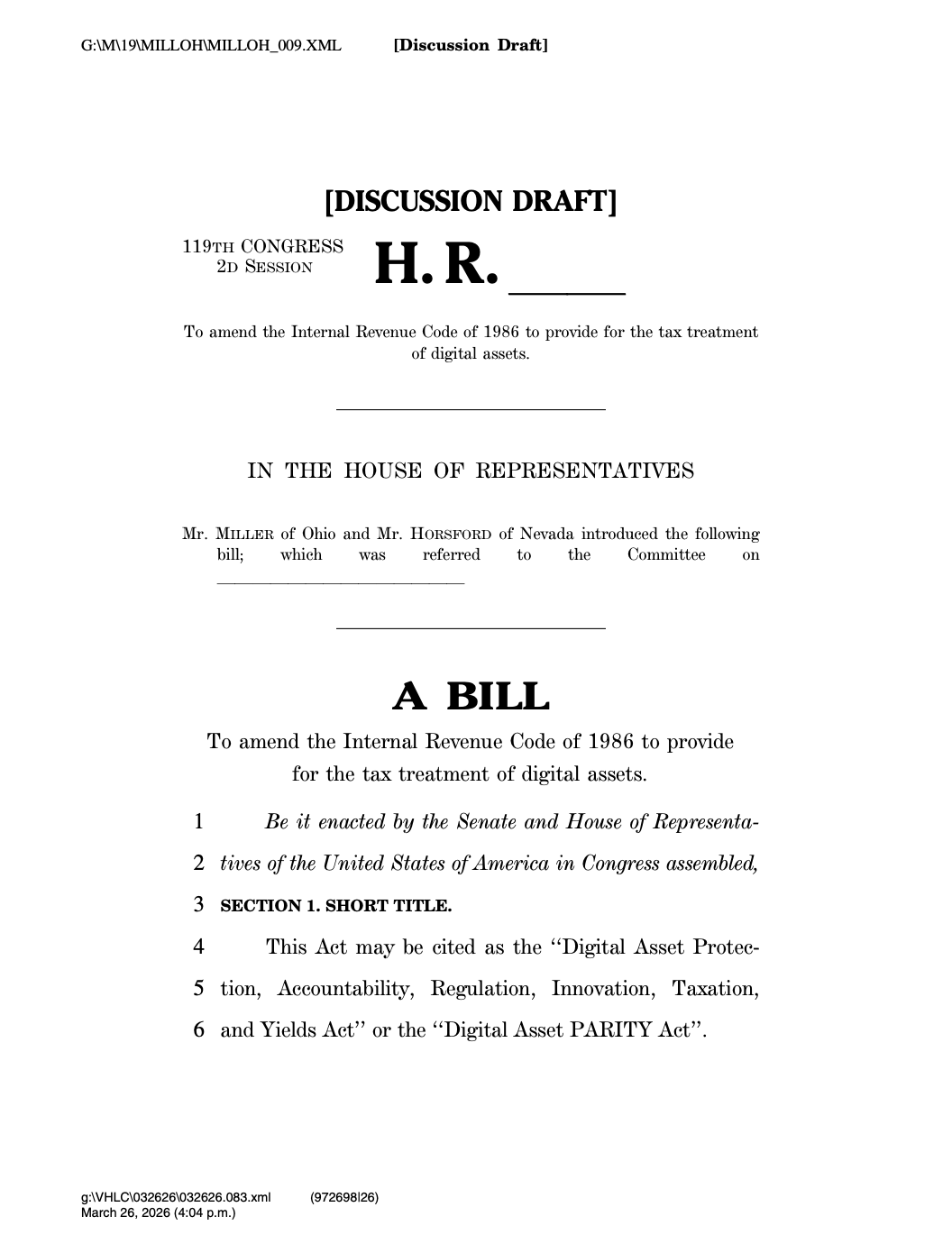
U.S. Representatives Max Miller and Steven Horsford have unveiled a discussion draft bill titled the 'Digital Asset Protection, Accountability, Regulation, Innovation, Taxation, and Yields Act' or the 'Digital Asset PARITY Act.' This proposed legislation aims to revamp the tax code concerning digital assets. According to Cointelegraph, the act seeks to amend the Internal Revenue Code of 1986 by introducing provisions to clarify the tax treatment of digital assets.
The draft legislation specifies that stablecoins will not be subject to gains if the cost basis, or the amount paid by the investor, remains within 1% of $1 or $0.01. Additionally, transaction costs incurred in acquiring or transferring regulated dollar-pegged stablecoins will not be included in an investor's cost basis. The bill also proposes a de minimis tax exemption for stablecoin transactions under $200, meaning such transactions would not trigger tax or reporting requirements, although the total annual exemption cap is yet to be determined.
Furthermore, the draft outlines that income from lending, staking, or passive validator services will be considered part of the recipient's gross income annually, calculated using the 'fair market' value. The Digital Asset PARITY Act has not yet been introduced to Congress and is currently a discussion draft intended to foster debate among lawmakers, stakeholders, and the crypto industry on how to reform crypto tax policy in the United States.
Cody Carbone, CEO of the crypto advocacy organization Digital Chamber, emphasized the need for digital asset tax clarity, warning that without it, activity may not fully onshore. However, some in the crypto community, such as Pierre Rochard, CEO of The Bitcoin Bond Company, have criticized the draft for only including a de minimis tax exemption for stablecoins and not for Bitcoin (BTC). Rochard argued that Bitcoin should have such an exemption, stating that stablecoins are not decentralized or permissionless and are merely fiat representations. The ongoing debate highlights differing views within the crypto industry regarding the proposed tax policy changes.