
I remember the night my brother and I sat in his tiny living room in Austin, late enough that only the hum of his mining rigs broke the silence, arguing about why crypto incentives so often feel rigged. He’s been trading and building in the U.S. crypto market for over 10 years — through bull runs, hacks, sideways doldrums, you name it — and when I brought up SIGN as a solution to airdrop fairness, what struck me was how visceral his reaction was: “If you can’t prove you’re human and unique, you’re a bot, full stop.” That simple sentence became the lens through which I really began to understand something deeper about identity in decentralized systems.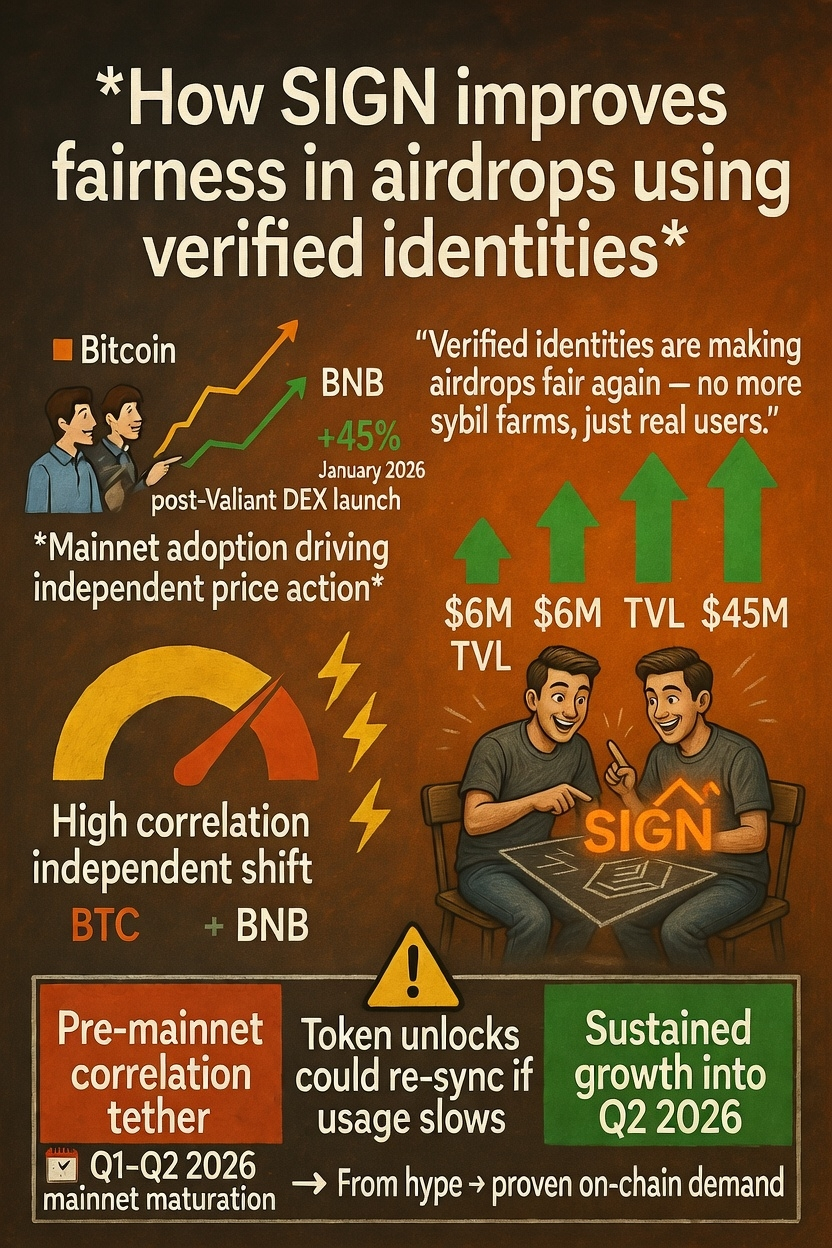 $SIGN
$SIGN
Right now, many airdrops — free token distributions meant to seed network effects — are plagued by the same old problem: sybil attacks. A spammer creates 100 wallet addresses; 100 times the tokens are claimed. That’s why proposals like SIGN aren’t just academic; they matter. When a protocol announces an airdrop, often only a tiny fraction of participants — somewhere in the low single digits — are actual unique individuals. Bots claim the rest.@SignOfficial
SIGN’s core idea is straightforward on the surface: tie each wallet to a verified, unique identity. You can’t double‑dip with 100 wallets if only one of them can ever be validated as uniquely you. Underneath, it uses cryptographic proofs, zero‑knowledge proofs, and attestations such that the verifier never sees your sensitive information — you prove you exist and are unique without handing over your passport or selfies. That’s a radical twist: proof without exposure.
Numbers bring this into focus. Imagine a protocol planning to airdrop 10 million tokens. With traditional snapshots, wallets with tiny balances and bots often inflate the recipient list to ~150,000 addresses, but analysts estimate that 65–75% of those could be duplicates or automated entities. The effective number of real participants might be closer to 40,000 humans. That’s not broad distribution — that’s an illusion of distribution.
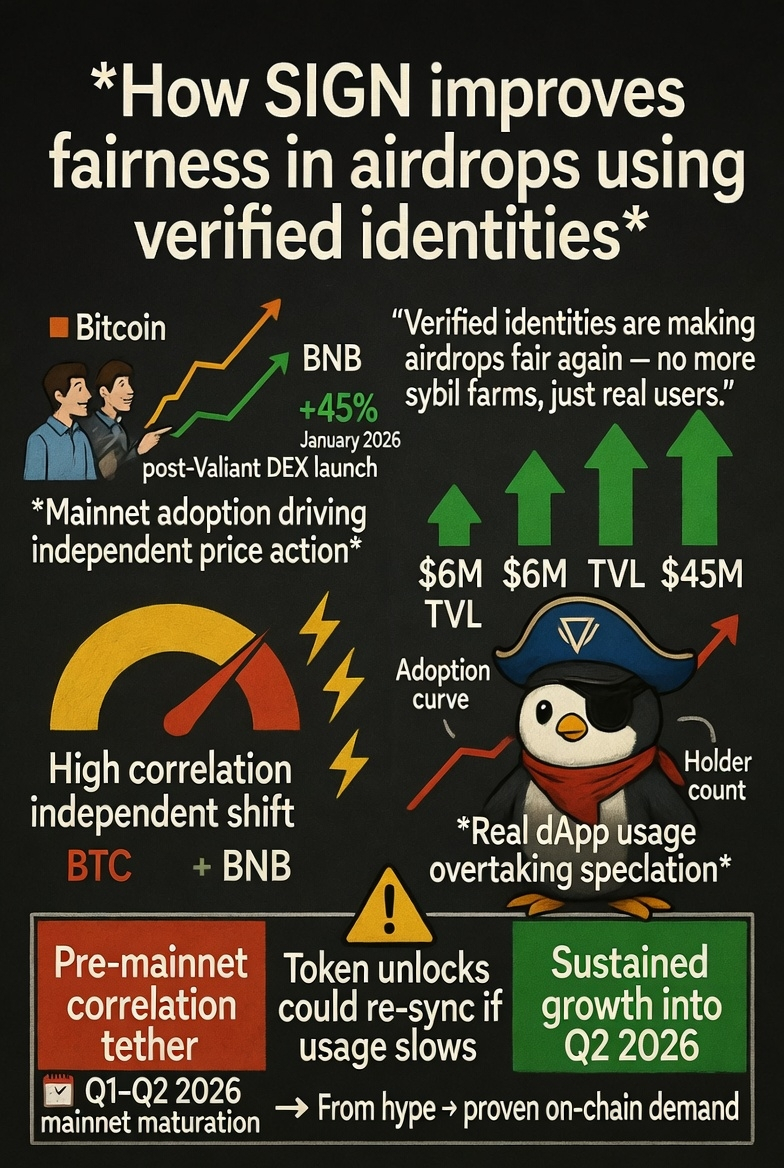
With a verified identity layer like SIGN, the same airdrop could target, say, 120,000 unique humans with better confidence. Those numbers matter because airdrops aren’t just giveaways — they’re on‑ramps for engagement. If your token hits 120,000 real users instead of 40,000 phantom ones, you’re more likely to see sustained activity, governance participation, and organic growth. That’s meaningful.
Underneath these mechanics are key enablers: selective disclosure and privacy preservation. You prove you are one unique human once, then reuse that proof across protocols without revealing extra data each time. This is both a strength and a risk. The risk is not technical exposure — SIGN’s cryptography handles that — but centralized attestation bottlenecks. If one identity provider becomes dominant, censorship or geopolitical restrictions could creep in. What good is a global airdrop if certain populations are blocked due to where attestations happen?
That brings me to a topic most analysts skirt: geopolitics in crypto identity. Sitting here in Pakistan and doing my research, it’s impossible to ignore geopolitical fault lines — from Iran to America, and now the elevated tensions involving Israel. If an identity network becomes intertwined with governance frameworks influenced by U.S. sanctions regimes, wallets associated with sanctioned regions might be excluded from airdrops — not because they’re bots, but because an attestation service fears legal exposure. Early signs suggest some protocols are already quietly doing geo‑IP blacklisting under the guise of “compliance.” That’s a slippery slope that undermines the ethos of decentralization. Projects should think hard about multi‑jurisdictional attestation — maybe even regionally federated attestations — so a Syrian developer or Iranian validator isn’t automatically token‑starved while traders in compliant regions thrive.
I also impressed upon my brother the safety features that so few talk about. Verified identities can drastically reduce rug pull scams where bad actors mint tokens, airdrop to bots, and then dump them for profit. If a protocol can credibly reject bot clusters, it reduces the economic incentive to manufacture engagement. That doesn’t fix all scams — economic incentives and tokenomics still matter — but it removes one vector of abuse.
Critics will ask: “Doesn’t verified identity sacrifice privacy?” Yes — if implemented badly. But SIGN’s nuance is in using cryptographic anonymity sets so you prove uniqueness without handing over a name, address, or IP. The real risk, ironically, is over‑centralization of attestation rather than the cryptographic system itself.
In the end, airdrops are about trust: trust that the distribution was fair, trust that bots didn’t swallow the pie, trust that you had a real shot. SIGN doesn’t remove all uncertainty — there will always be edge cases, governance disputes, technical bugs — but it realigns incentives toward real humans instead of scripts and proxies. That’s more than a technical upgrade. It’s a cultural shift in how we think about who participates in crypto.
What I’m left with, long after the arguments with my brother, is this: if value in crypto continues to accrue not to wallets but to verified humans, we might just edge closer to the inclusive, permissionless world the early pioneers promised — without trading away privacy or falling into the trap of jurisdictional exclusions. That’s a balance worth watching.@SignOfficial #SignDigitalSovereignInfra