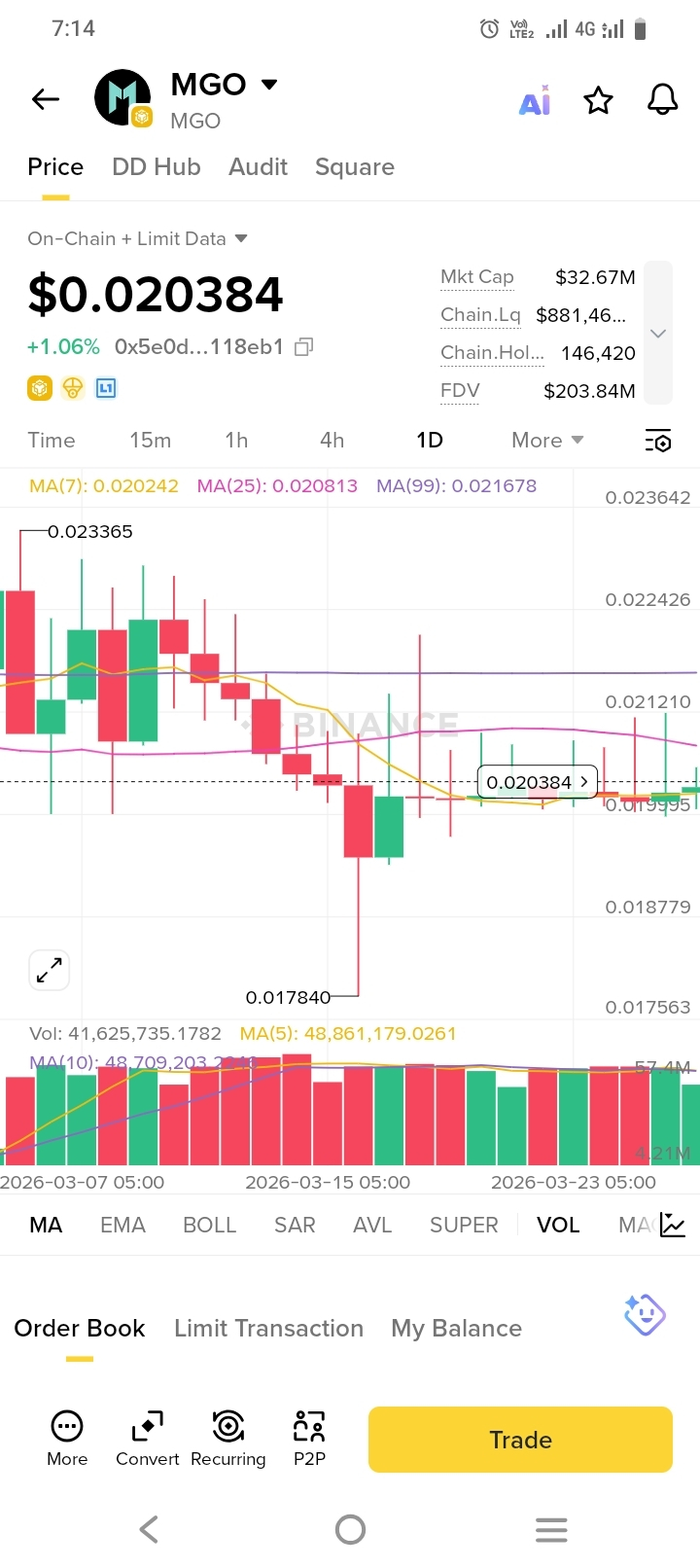
MGO is the native token of Mango Network, a Layer-1 blockchain project aiming to solve one of the biggest problems in crypto today — fragmentation between different blockchain ecosystems. Instead of competing directly with chains like Ethereum or Solana on speed alone, MGO focuses on interoperability and usability, which is a smarter long-term angle.
🚀 Core Idea & Technology
At its foundation, Mango Network introduces a multi-VM (Virtual Machine) architecture, supporting both EVM (Ethereum) and MoveVM environments in one chain.
This is important because:
Developers can build across multiple ecosystems without rewriting code
It reduces reliance on risky bridges
It improves liquidity flow between chains
In simple terms, MGO is trying to become a “connector layer” for Web3, not just another standalone blockchain.
⚙️ Utility & Real-World Use
MGO is not just a speculative token — it has real utility inside its ecosystem:
Gas fees for transactions
Governance voting
Staking & validator rewards
Payments in gaming and loyalty systems
The project is strongly positioned in GameFi + payments + DeFi, which are high-growth sectors in crypto.
📊 Tokenomics (Quick Insight)
Fixed supply (large-scale distribution model)
Community-heavy allocation (~50%)
Burn mechanism to control inflation
Staking incentives for network security
This structure is generally investor-friendly, but full unlock strategies can sometimes create early selling pressure.
🛠️ Development Progress
From a development standpoint, MGO is still early-stage but active:
Built on a modified Tendermint consensus (focus on scalability + security)
Working toward high throughput and low latency
Already gaining attention in the market as a trending Layer-1 token
The project is clearly focusing more on infrastructure maturity rather than hype, which is a good sign.
🗺️ Roadmap Highlights
MGO’s roadmap is centered around gradual ecosystem expansion, not quick hype-driven milestones:
✅ 2025
Initial network launch
Exchange listings
Early ecosystem development
🔄 2025–2026
Bitcoin Layer-2 integration (major step for interoperability)
Expansion into DeFi, GameFi, and SocialFi
Developer onboarding
🔮 2026–2027
Performance optimization (TPS, latency improvements)
Ecosystem scaling
Real-world adoption focus
The roadmap shows a long-term vision, not a short pump-and-dump cycle.
📈 Strengths
✔️ Unique multi-VM architecture (real innovation)
✔️ Strong focus on interoperability (future of Web3)
✔️ Expanding use cases (gaming + payments + DeFi)
✔️ Active development and roadmap clarity
⚠️ Risks
❗ Still a low-cap / early-stage project
❗ Needs real adoption (developers + users) to succeed
❗ Competing with strong Layer-1 ecosystems
❗ Market sentiment heavily affects price
🧾 Final Verdict
MGO is a fundamentally interesting project with real technical ambition. It’s not just another meme coin — it’s trying to build infrastructure for the future of Web3.
However, its success depends on one key factor:
👉 Can it attract developers and real usage?
If yes, MGO could become a strong player in the Layer-1 space.
If not, it may struggle like many other technically solid but underused projects.