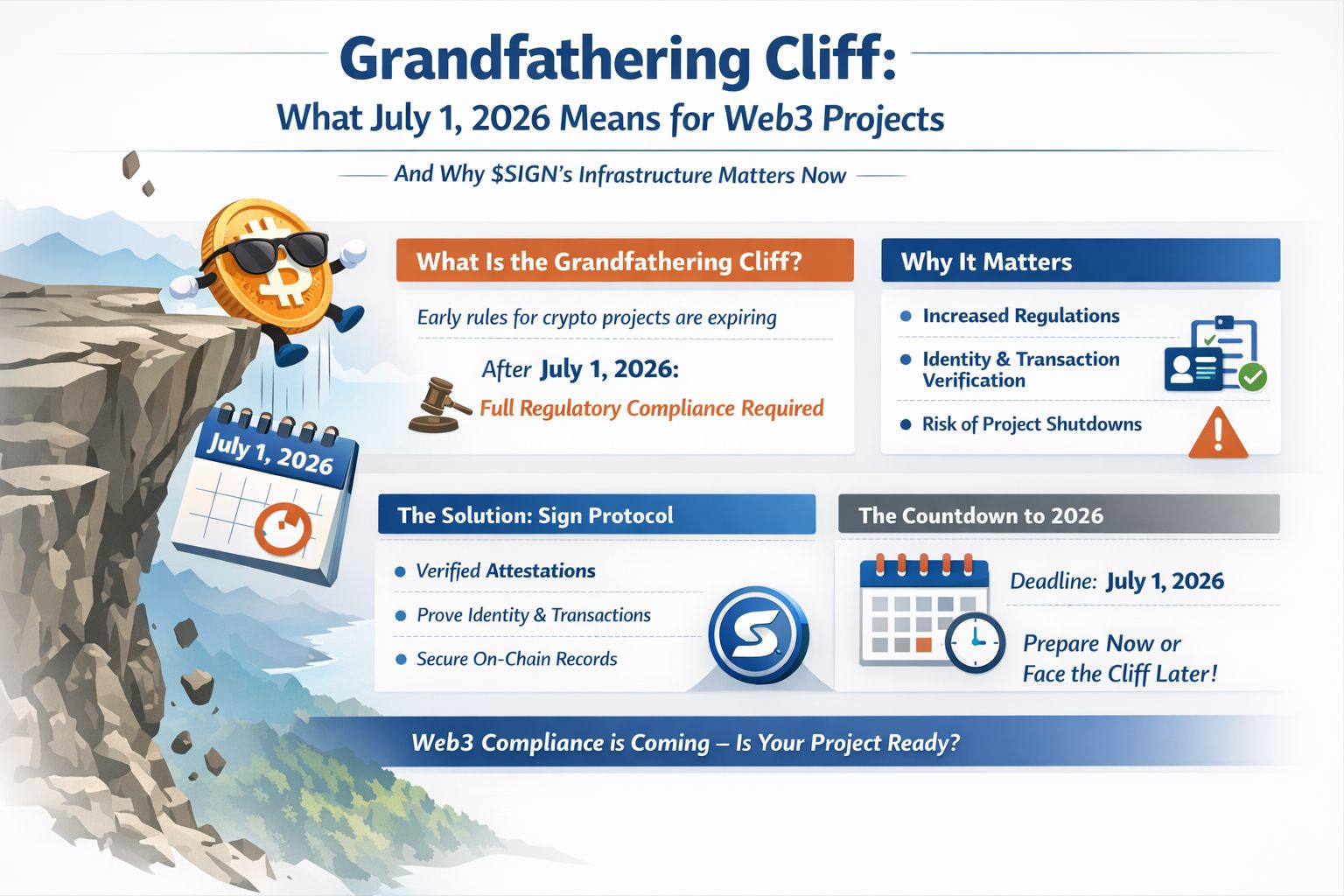
The deadline is approaching that few people in crypto are discussing nearly enough. July 1, 2026 is the date when many Web3 projects will meet what some experts are referring to as a “grandfathering cliff.” This essentially means rules and protections that were provided to early crypto projects will soon vanish. After that date, many projects will need to comply with the same stringent regulations as traditional finance firms. Some projects are ready. Most are not.
What Is a Grandfathering Cliff?
Think of it like this. When new laws enter the picture, governments occasionally grant existing businesses a grace period to adapt. That period is known as grandfathering. It allows old projects to continue operating under old rules while they work out how to comply with new requirements.
Well for Web3, that time is fast running out. For a few years now, regulators in the US, Europe and parts of Asia have been gradually laying out crypto laws. That mob of expiration dates all happens the same day, July 1, 2026. Projects conceived before some rules took effect won’t get a free pass anymore. They must demonstrate compliance or risk penalties.
Why This Is a Big Deal
Many Web3 projects were rushed into the making. They now centered on technology and community. Legal structure was an afterthought much of the time. That worked for a while. That's no longer going to work.
The projects most likely to struggle are the ones that can’t identify who their users are, have no clear transaction history and around whom there is no verification system in place. Regulators want to ensure that crypto projects know their users and can trace cash flows. If you don’t have that, it’s very difficult to operate legally.”
Lesser projects simply might stop operation. Some will have to scramble and cobble compliance tools together at the last moment. That almost never goes well.
Where $SIGN Comes In
That is where Sign Protocol and its token SIGN shine. At its core, Sign Protocol is a layer of infrastructure. Attestation is simply a claim that is verified. It allows one party to say that to another, “this is true and I can prove it.”
To put it simply, SIGN allows projects to provide proofs. A project can use it to validate that a user is indeed who they claim to be. It can verify that a transaction occurred in a particular way. It allows to attach actual, verifiable records to on chain activity.
And this is precisely what regulators are demanding. They want proof. They want records. They want accountability. The Sign Protocol is constructed to offer all of this without requiring projects to sacrifice the decentralized nature that underpins Web3 value in the first place.
Why the Timing Matters
Building compliance tools takes time. If a project doesn’t step back until June 2026 to consider this, it is far too late. The projects who will survive the grandfathering cliff will be those that prepared early.
Sign Protocol provides a plug-in for verified identity and record keeping to Web3 builders who don’t want to reinvent everything from scratch. It works across chains. It is open. And it integrates seamlessly into the way most projects are built already.
The SIGN token is related to how the network operates. As the use of attestations to satisfy compliance needs proliferates across projects, so does the demand for the underlying infrastructure. That’s not a speculative story. It is a practical one.
The Bottom Line
July 1, 2026 is not just another date on a calendar. It will be a watershed moment for Web3. Projects that actually have infrastructure behind them will continue. Those that don’t will have some hard choices to make.
$SIGN is not just a token. It is a part of the answer to an urgent problem that is coming much faster than most people understand. @SignOfficial #SignDigitalSovereignInfra $SIGN