
I wasn’t testing the Sign protocol today.
I was trying to keep up with it.
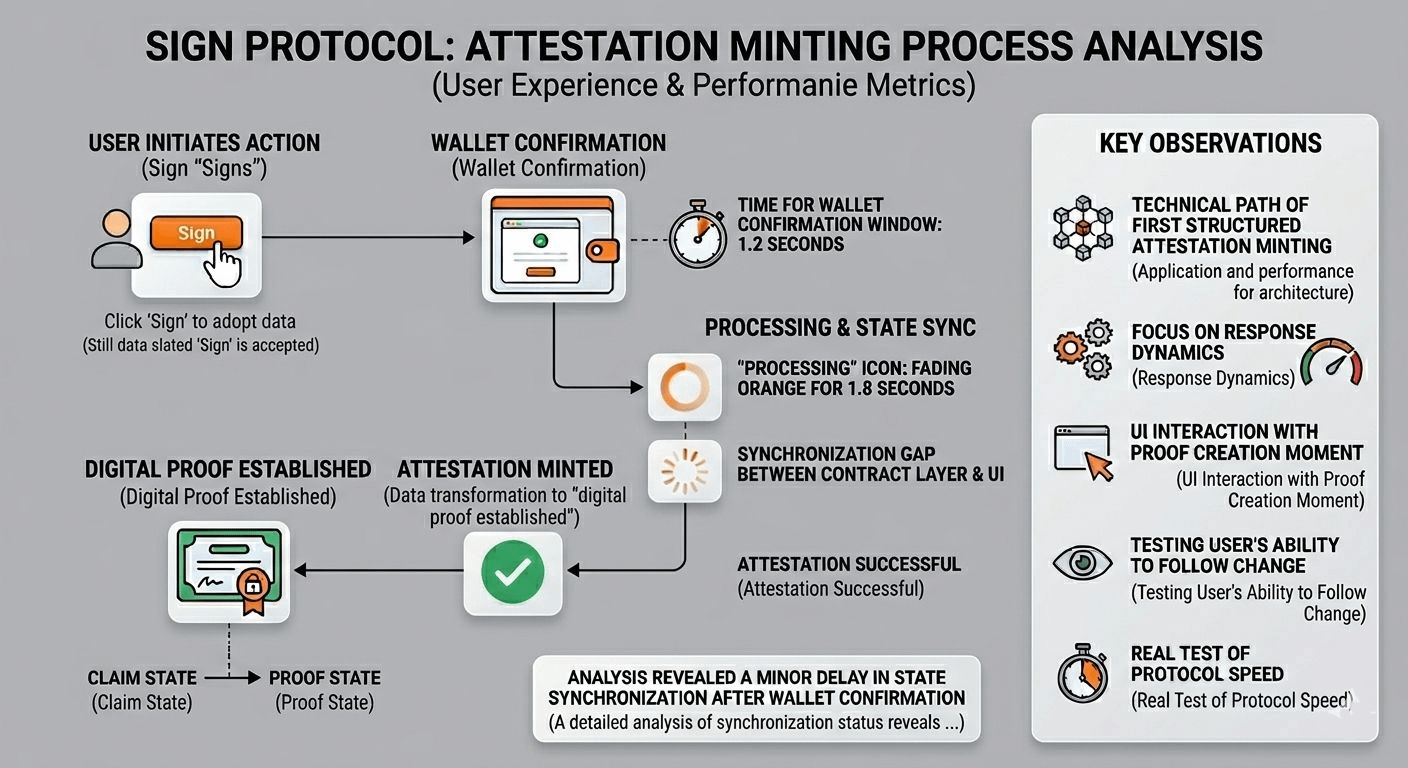
The moment I initiated the attestation, everything unfolded faster than my own awareness. Click “Sign” — wallet pops up almost instantly. Confirm — and before the action fully settles in my mind, the system has already moved on.
Processing… done.
No friction. No pause. No space to reflect.
And that’s exactly where it becomes interesting.
Because what’s being created here isn’t just a transaction—it’s evidence. Something persistent. Queryable. Potentially consequential beyond the moment of interaction.
Yet the system treats it like a lightweight event.
When I checked the explorer, the attestation was already there. Not “pending,” not “forming”—just existing. As if the transformation from data to proof didn’t require a journey.
But for the user, it does.
There’s a missing layer between doing and understanding. A silent compression of steps that used to carry meaning:
Review
Intent
Confirmation
Finality
Now they collapse into a near-instant blur.
Even the success message barely lingers. It appears, then disappears—like the system assumes you don’t need reassurance. Like certainty is implied by speed.
But speed doesn’t always translate to clarity.
What I felt wasn’t confusion—it was temporal dissonance.
The protocol is already operating in a “post-verification” state, while the user is still mentally processing the act of signing.
Execution is no longer waiting for comprehension.
And maybe that’s the real shift here:
We’re moving into systems where proof is generated in real-time, but understanding remains delayed.
That gap—small in seconds, but large in perception—might define the next phase of user experience in on-chain identity.
Because when something becomes permanent faster than you can internalize it, the question isn’t just “Did it work?”
It’s:
“Did I fully realize what I just made real?”
@SignOfficial #SignDigitalSovereignInfra $SIGN
