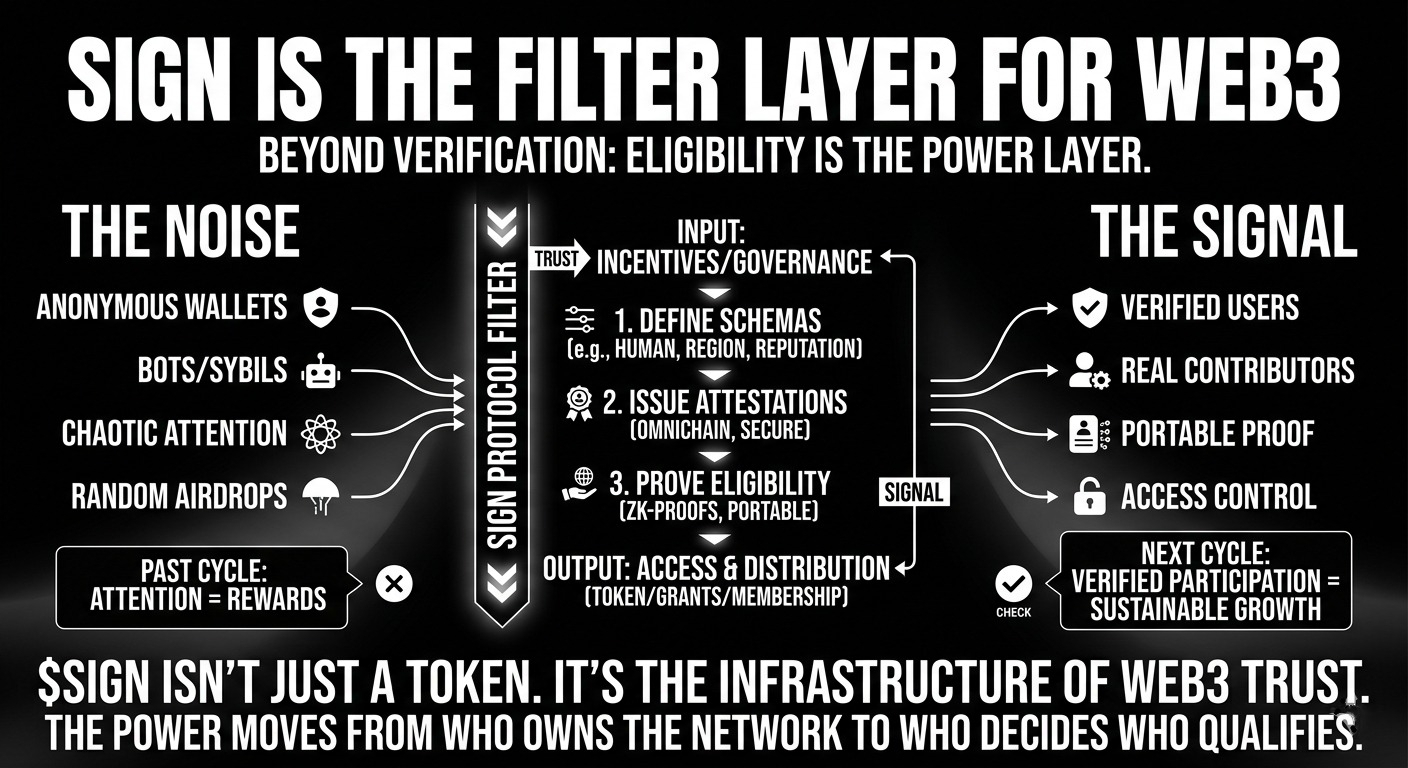
Most people look at SIGN and see a project about credentials, verification, and eligibility.
That sounds useful.
But also easy to ignore.
Because “verification” doesn’t feel as exciting as memes, AI, or the next high-beta token.
That’s exactly why many are missing the point.
The common assumption is simple: SIGN is just infrastructure for proving who qualifies for something.
Airdrops, allowlists, grants, memberships, campaign rewards.
Useful, yes.
But narrow.
What most people are missing is that eligibility is becoming one of the most important control layers in Web3.
Who gets access?
Who gets filtered out?
Who can prove they belong without giving away everything?
That question is getting bigger, not smaller.
As crypto grows, projects can’t treat users like anonymous wallets forever.
They need better ways to verify participation, reputation, location, contribution, or community status.
Not with endless paperwork.
Not with blind trust.
And not with systems that expose more data than necessary.
That’s where SIGN becomes more interesting.
It’s not just about storing credentials on-chain.
It’s about creating a system where proof can travel.
A user can show they meet a condition.
A protocol can verify it.
An ecosystem can build around it.
That matters because Web3 is entering a stage where access is no longer random.
The first cycle rewarded attention.
The next cycle may reward verified participation.
That changes how incentives work.
It changes how communities defend themselves from bots and sybil attacks.
It changes how real contributors get recognized.
And it changes how value is distributed.
If identity was the problem, eligibility may be the business model.
That’s the deeper insight here.
Projects don’t just need users.
They need ways to separate noise from signal.
And users don’t just want rewards.
They want portable proof that they actually earned a place in the network.
This is where $SIGN becomes more than a token attached to a niche product.
If SIGN becomes part of the trust and verification layer for Web3, then it sits closer to decision-making than people think.
Not flashy decision-making.
But the quiet kind that determines who gets in, who gets paid, and who gets ignored.
That kind of infrastructure often looks boring early.
Until suddenly every serious protocol needs it.
Of course, there’s risk.
If Web3 keeps favoring loose, low-friction participation, systems like this may stay underused.
And if verification becomes too centralized or too rigid, it can push users away.
That tension is real.
But that’s also why this space is worth watching.
Because the future of crypto may not be decided only by who builds the biggest chain or the fastest app.
It may also be decided by who builds the rules for trust without overexposure.
SIGN is betting that credentials and eligibility won’t stay in the background.
They’ll become part of the core rails.
And if that happens, ignoring projects like this now could look less like caution—
and more like a blind spot.
In Web3, the next power layer may not be who owns the network.
It may be who decides who qualifies.
$SIGN @SignOfficial #signdigitalsovereigninfra