
$SIGN #SignDigitalSovereignInfra @SignOfficial

Most systems don’t actually need to know who you are.
They just don’t know how to operate without asking.
That’s the gap SIGN is built around.
You try to access something simple. A platform, a service, a feature. The decision itself is narrow. It depends on one condition. But the system doesn’t ask for that condition. It asks for you.
Full identity. Documents. Details that have nothing to do with the decision being made.
At first it feels like security. Then it starts to feel like habit.
I didn’t really question identity checks until I saw how often they’re used where they don’t belong.
At first it feels normal. You sign up somewhere, they ask for your ID, maybe a selfie, maybe proof of address. It looks like compliance. It looks like protection.
But then you look closer at what the system actually needs to decide.
Most of the time, it’s not trying to know who you are.
It’s trying to decide something much narrower.
Can you access this product. Are you allowed in this region. Do you meet a threshold.
That’s not identity.
That’s eligibility.
The strange part is how rarely systems make that distinction.
They default to identity even when the decision doesn’t depend on it.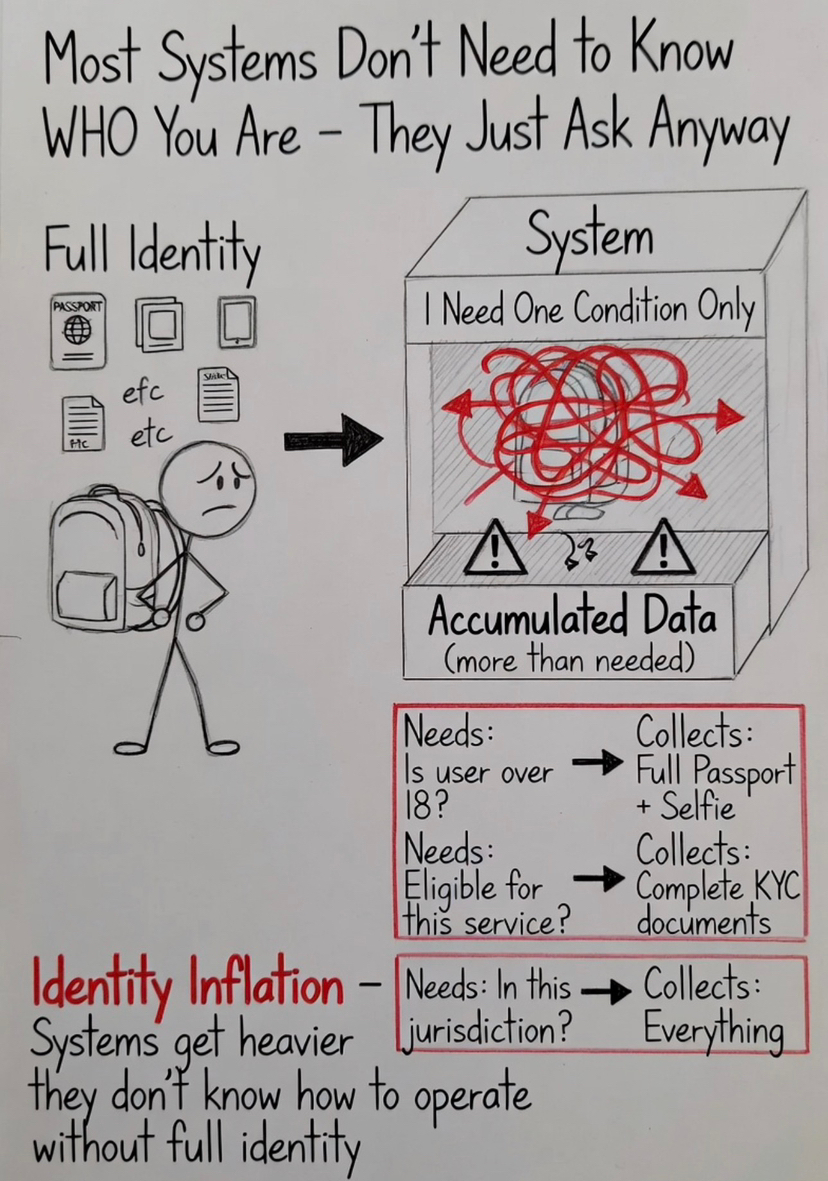
A platform needs to restrict access to adults. Instead of checking age, it collects full identity. A service needs jurisdiction filtering. Instead of checking residency status, it collects documents. A financial product needs compliance clearance. Instead of checking status, it rebuilds the user from scratch.
Each time, the system reaches for identity because it doesn’t have a way to operate without it.
Most systems don’t collect identity because they need it. They collect it because they don’t know how to operate without it.
That’s where the inefficiency hides.
Not in verification.
In what gets verified.
Because identity is the heaviest possible input.
It contains more information than most decisions require. Once collected, it tends to persist. And once it persists, it becomes part of the system whether it’s needed or not.
So even when the system only needs one condition, it ends up carrying everything.
That’s why identity keeps expanding in places where it shouldn’t.
I started noticing something else.
Once identity enters the system, it becomes hard to reduce it again.
The system derives what it needs, but it doesn’t forget what it learned.
So over time, the system accumulates data that was never necessary for the decisions it actually makes.
That’s not just inefficient.
It changes the risk profile.
Because now the system holds more than it needs, processes more than it uses, and exposes more than it should.
All of that, just to answer a smaller question.
This is where the distinction becomes practical, not theoretical.
Identity proof is about reconstructing the person.
Eligibility proof is about confirming a condition.
Those two flows don’t just differ in scope.
They differ in how systems behave around them.
Identity proof pulls data inward. Eligibility proof pushes a decision outward.
And that shift is where SIGN stops being optional.
Because without a way to express eligibility directly, systems default back to identity inflation.
What changes with SIGN is not how identity is verified.
It’s what happens after.
Instead of treating identity as the input for every decision, the system produces a set of claims that reflect what has already been established.
Not everything about the user.
Only what matters.
Eligible for a specific service. Meets a defined compliance level. Within a required jurisdiction boundary.
These are not derived internally and kept hidden.
They are expressed explicitly, tied to a schema, and signed by the issuer that performed the verification.
So the meaning stays fixed and the source of that meaning is clear.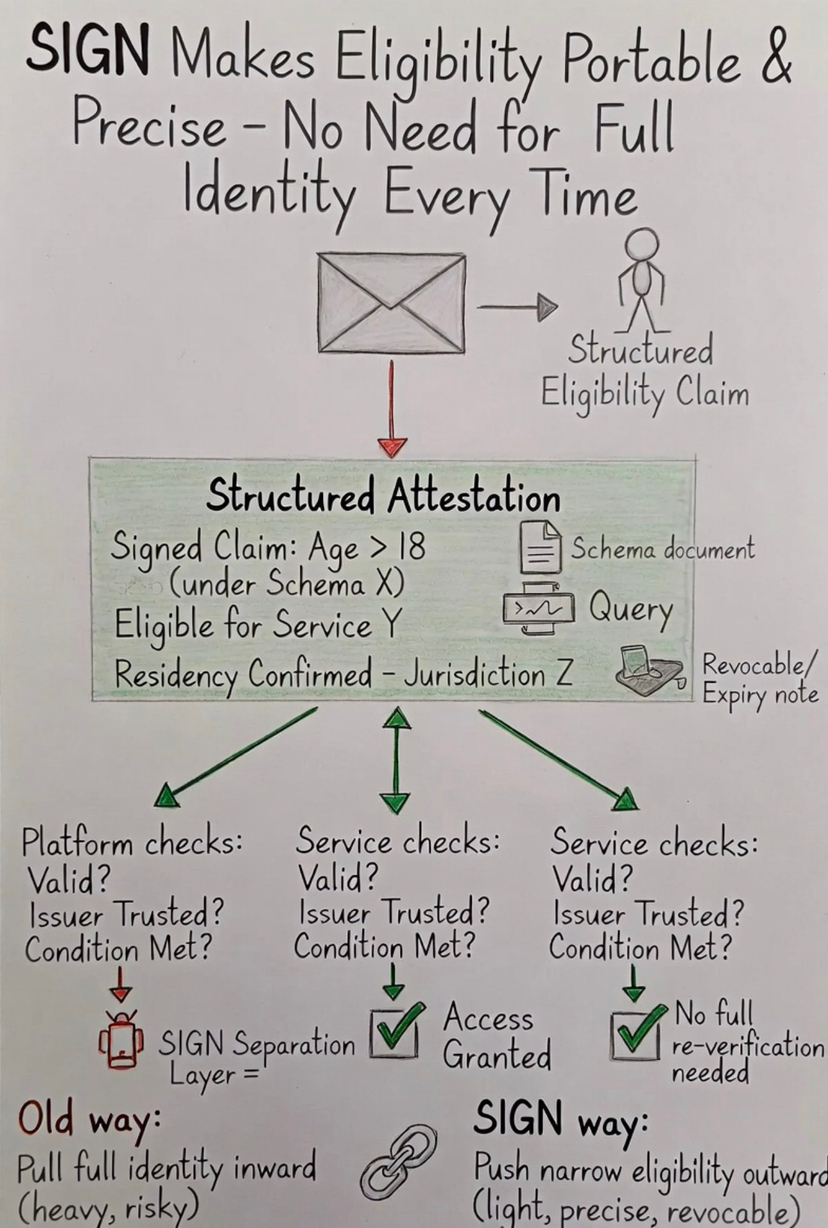
Now the next system doesn’t need to reconstruct the user.
It needs to evaluate the claim.
That changes the interaction in a subtle but important way.
The system is no longer asking for identity as raw input.
It is resolving whether a condition has already been satisfied under rules it accepts.
And that’s where things become more precise.
Because the system only processes what it needs.
Not everything that happens to be available.
I’ve seen this play out in cases where identity-heavy systems start breaking under their own weight.
Users complete full verification, but the system still needs additional checks because it can’t isolate the exact condition it depends on.
So instead of becoming simpler over time, it becomes layered.
More data, more rules, more friction.
The problem isn’t lack of information.
It’s lack of separation.
SIGN enforces that separation by making eligibility something that can stand on its own.
Not inferred each time, but issued once and reused where applicable.
That doesn’t remove trust from the system.
It makes trust more specific.
Because now each claim is tied to:
a defined meaning an issuer responsible for it and a structure that doesn’t change across systems
So instead of one system trying to understand another system’s internal logic, they rely on a shared representation of the outcome.
There’s also something else that becomes visible when you look at it this way.
Eligibility is not permanent.
It can expire. It can change. It can be revoked.
Identity doesn’t capture that well.
It tells you who someone was verified as, not whether they still meet a condition.
That’s why identity-based systems often drift.
They verify correctly.
But they don’t stay correct.
With structured eligibility, that state can be updated.
The claim changes, not the entire identity process.
So the system doesn’t rely on outdated assumptions.
It resolves current conditions.
This is where things start to feel different.
Not because the system is doing less work.
But because it’s doing the right work.
Instead of verifying everything again, it checks whether what matters is still valid.
And that’s a much smaller problem.
Once you separate identity from eligibility, a lot of the pressure disappears.
Systems stop collecting unnecessary data. Users stop repeating the same process. Decisions become clearer because they’re based on exactly what they require.
It also changes how systems scale.
Because they’re no longer tied to full identity reconstruction at every step.
They operate on verified conditions that can move across boundaries without expanding.
That’s the part that feels under-discussed.
Most improvements in identity focus on making verification better.
But the bigger shift is reducing how often verification is needed.
SIGN fits into that shift by making eligibility portable.
Not as a side effect, but as the primary unit of interaction.
Identity still exists.
It just stops being the default answer to every question.
And once that happens, systems become lighter, more precise, and easier to align.
Because they’re no longer asking for the whole person when they only need one condition.
That’s where the difference shows up.
Not in how identity is proven.
But in how little of it needs to be used.
Because if every decision requires full identity, then the system isn’t becoming smarter.
It’s just becoming heavier.