We spend our lives collecting receipts.
A diploma from a university that took four years to earn. A deed to a house that took thirty years to pay off. A specialized certification that proves you actually know how to do the job you’re being paid for. In the physical world, these things are heavy. They live in filing cabinets, or they’re PDFs sitting in an inbox, waiting for a human at a bank or a government office to verify them and manually type that data into another system.
It’s slow, it’s expensive, and in a digital-first world, it’s starting to feel broken. We call this "due diligence," but really, it’s a tax on trust. Because we don’t have a shared way to prove things are true, we pay for the friction of proving them over and over again.
The Rise of Sovereign Infrastructure
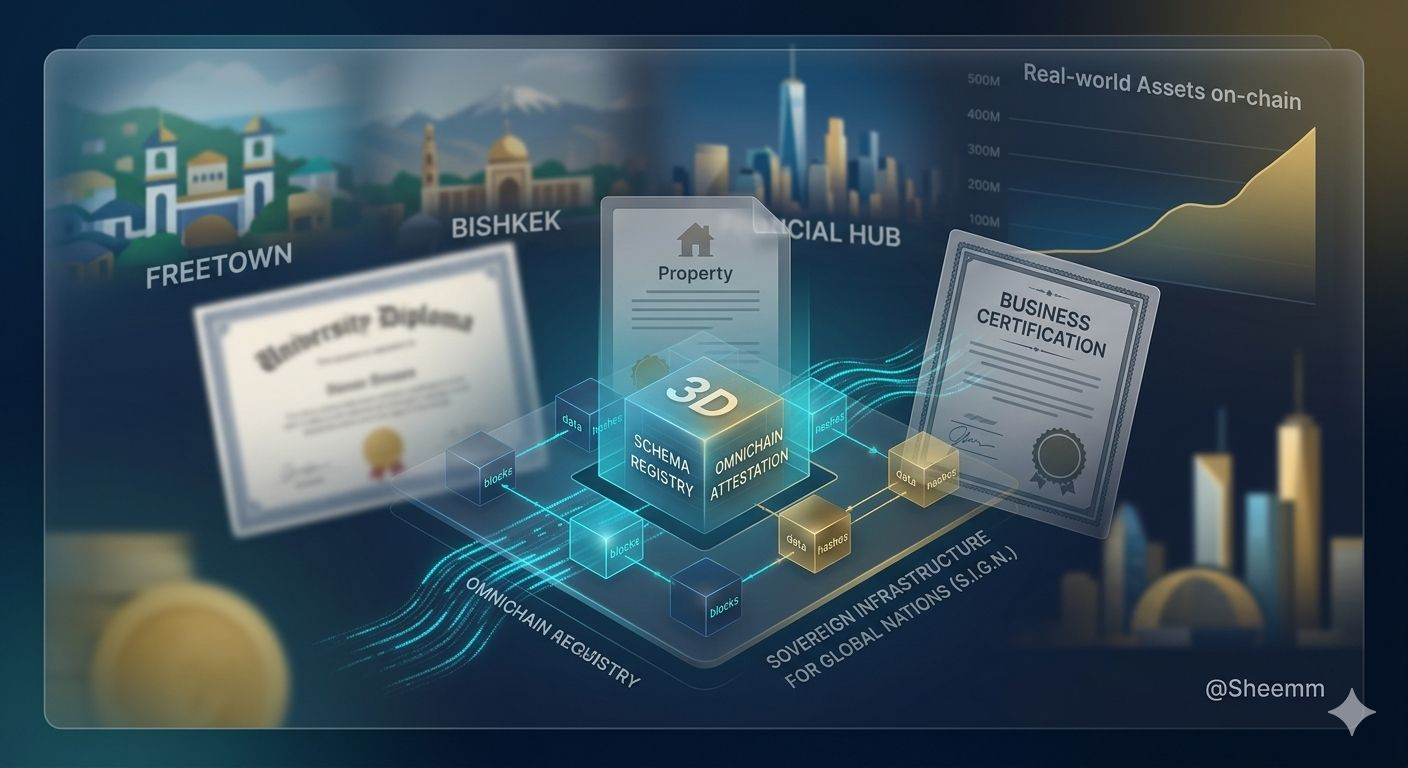
This is where the conversation around Sign Protocol usually gets technical—people start talking about omnichain attestations and schema registries. But if you strip away the jargon, what they’re actually building is a Universal Translator for Truth.
In 2026, we are seeing the emergence of S.I.G.N. (Sovereign Infrastructure for Global Nations). It’s a vision where national systems for identity, money, and capital aren't owned by a single corporation or locked into one database. Instead, they run on a decentralized layer that is tamper-proof and globally queryable.
Think about the implications for Real-World Assets (RWA). We’ve spent a decade putting "money" on the blockchain. Now, we’re putting reality there. If a coffee farmer in Ethiopia can prove their harvest was fair-trade through a cryptographically signed attestation, they don’t need a middleman to vouch for them. If a small business can prove its revenue history through a verified record, it can get a loan from a DeFi protocol in seconds. This isn't just a "crypto" trend; it’s the plumbing for a new global economy.
Proof Without Permission
The brilliance of an omnichain approach is that it solves the "Amnesia Problem." Right now, Web3 feels like walking into a room where nobody knows you, even if you’ve been a power user for years. You’re just a hex address.
With Sign Protocol, your "existence"—your contributions, your credentials, your history—becomes a layer that follows you. It’s not your name or your private details; it’s just the proof of what you’ve done. You show up somewhere new, and instead of starting from zero, there’s a trace.
The Future of Distribution
We see this most clearly in how value moves. Today, airdrops and incentives often feel like guessing games. You click buttons and hope you’re "early" or "lucky." But when distribution leans on actual, verifiable history, it stops feeling random. It becomes harder to ignore consistent contributors when the system finally has something real to look at.
We’re moving toward a world where your achievements aren't just stories you tell—they’re facts that follow you. It’s a quiet revolution. There’s no big announcement when it works; it just removes the friction of having to explain yourself again. It’s the feeling of moving somewhere new and, for the first time, being recognized for having existed already.
No introduction required. No reset. Just a system that, for once, doesn’t forget you the second you leave.