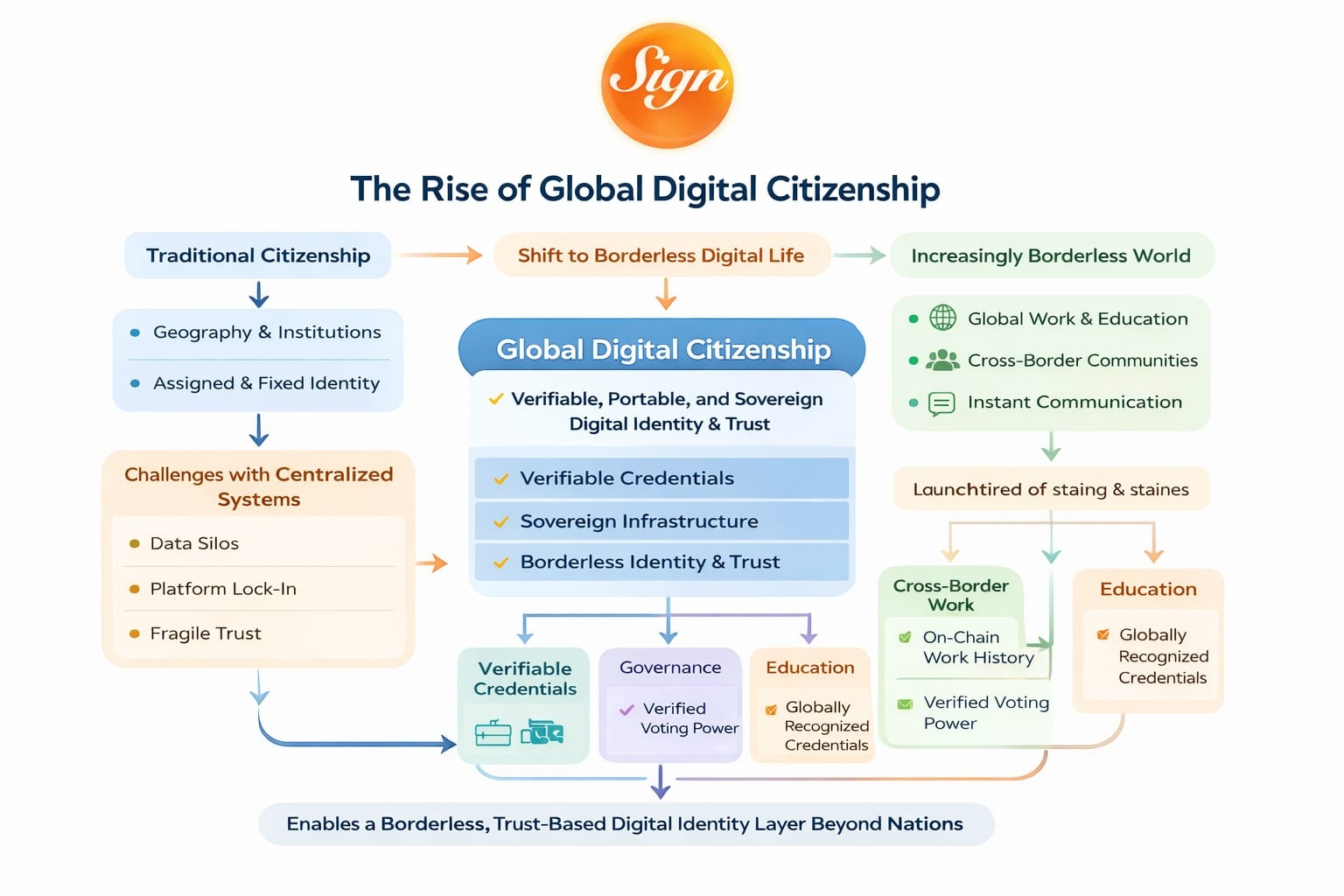
For most of my life,citizenship felt like something fixed tied to geography,paperwork,and institutions I had no control over.It was something assigned to me,not something I actively held.Honestly,I never thought much about it.I just accepted it.
But over time,that idea started to feel outdated. Life was moving online,and suddenly borders didn’t seem as relevant. Work,communities,education even conversations about governance happened across time zones and continents. I found myself participating in global networks more than local ones,and I realized something:if our lives are becoming borderless,our systems of identity and trust need to evolve too.
That’s when the idea of global digital citizenship started to make sense and why sovereign infrastructure matters.
Sovereign infrastructure flips a fundamental assumption:instead of institutions owning identity and trust,individuals do. Systems like Sign helped me understand this in practice.Instead of logging into platforms and rebuilding reputation from scratch,you carry verifiable credentials with you. Your identity becomes something you hold,not something granted.
This shift didn’t happen overnight.It crept up as centralized platforms grew more powerful and more limiting.Data silos,platform lock in,and fragile trust models exposed a core problem:we were relying too heavily on intermediaries to define who we are and what we’ve done.
Sign approaches this differently.Credentials proofs of participation,contribution,or identity exist independently of any single platform. They’re verifiable,portable,and resistant to manipulation. Instead of saying “trust me,” you can show it.It might sound abstract,but the applications are real.I think about cross border work,for instance.Instead of relying on resumes or platform ratings,you could present on chain credentials that verify your experience.In governance,voting power could be tied to verified participation rather than opaque systems.Even education could shift:certifications would belong to learners and be recognized globally.
What really changed my perspective wasn’t just the technology it was realizing how much power infrastructure holds.The systems beneath the surface decide who gets access,who gets recognized,and who gets excluded.Centralized systems concentrate control;sovereign,verifiable ones distribute it.
I won’t lie I’ve become a little obsessed with this space.It’s not just better tech;it’s redefining how trust works on a global scale.
Global digital citizenship isn’t about replacing nations.It’s about creating a parallel layer where identity,trust,and coordination operate beyond borders securely and independently.And if that layer becomes the default,the real question isn’t where you’re from it’s what you can prove,anywhere in the world.