
I’m watching… I’m noticing something small that keeps repeating, and it’s starting to bother me more than it should… the internet still doesn’t know how to introduce people properly, and every time one system hands you over to another, something breaks quietly in between.
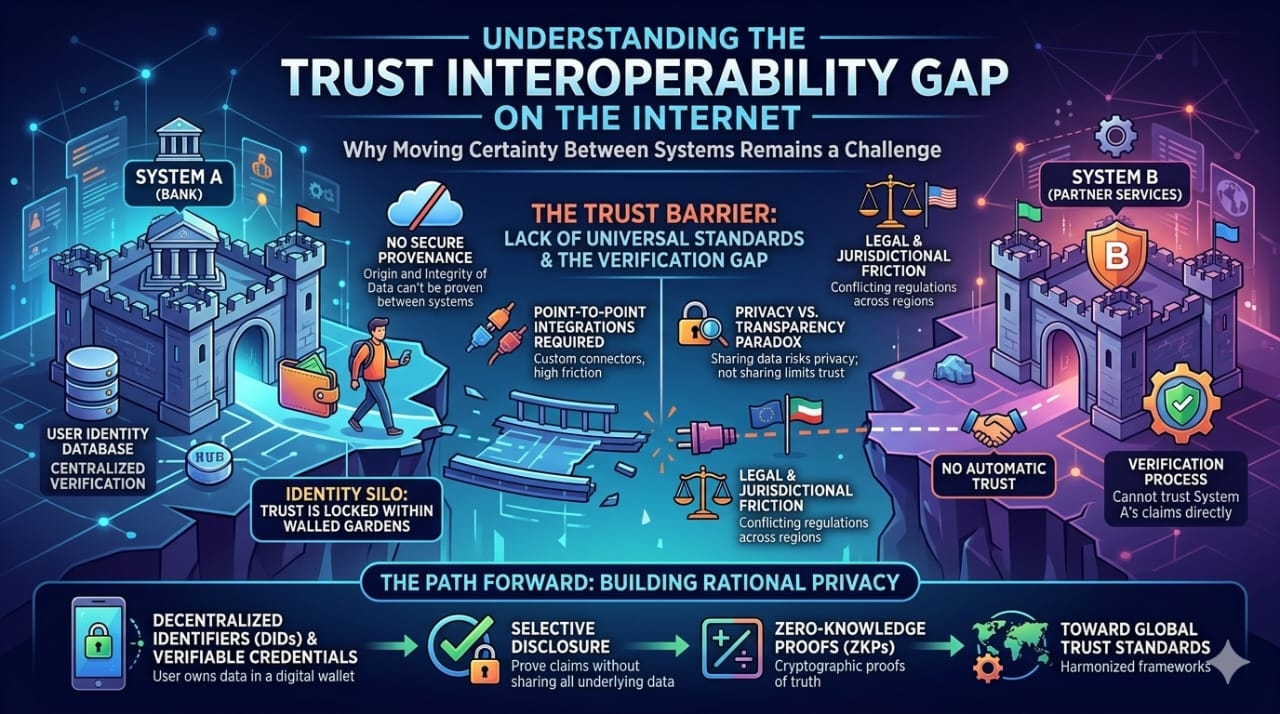
What $SIGN makes me think about… isn’t identity, and it’s not tokens either.
It’s this hidden dependency the internet still has on introductions.
Not the social kind.
The structural kind.
One system basically telling another:
“this person is real”
“this person qualifies”
“you can trust this”
And somehow… that simple handoff is still messy.
Because the internet doesn’t struggle with storing data.
It’s full of records.
Your activity, your history, your ownership, your credentials… everything is already there.
But storing something… is not the same as making another system *believe* it.
That’s where things start slipping.
Inside a system, everything feels clean.
It knows you. It understands your actions. It trusts its own data.
But the moment that trust has to move somewhere else…
everything resets.
You get checked again.
Asked again.
Reviewed again.
It’s like starting from zero every time.
And that’s when you realize something important…
Trust online is still local.
A platform may trust you fully.
But the next one… doesn’t care.
So now someone has to step in between.
Translate.
Verify.
Confirm.
That’s the friction people ignore until it slows everything down.
Because the real problem isn’t whether a claim exists.
It’s whether that claim can travel…
and still mean something when it reaches somewhere new.
That’s where SIGN becomes interesting to me.
Not because it’s adding something new on the surface…
but because it’s trying to clean that messy handoff.
A system saying:
this came from a real source
this proof is still valid
this condition was met
And another system… just accepting it.
If that works, even basic things change.
Take token distribution.
People think it’s just about sending tokens.
But it’s not.
It’s about why someone receives them.
Did they contribute?
Did they qualify?
Did they belong?
The token is just the outcome.
Behind it… there’s always a reason that needs to be trusted.
So really, it’s one flow:
first something is proven
then something happens because of it
And that connection… is where most systems break.
If it’s weak, everything becomes manual again.
Lists.
Sheets.
Approvals.
Waiting.
I’ve seen this myself… even simple campaigns or rewards get messy fast when systems don’t trust each other, everything turns into checking and re-checking instead of just flowing.
That’s why this layer matters more than it looks.
Not hype.
Not big claims.
Just quiet infrastructure:
who issued it
is it still valid
can it be revoked
does it actually belong to you
Simple things… but they decide whether a system holds up or falls apart later.
And honestly, from a human side… this is where it hits the most.
No one likes repeating themselves.
Prove again.
Explain again.
Connect again.
It’s small… but it adds up.
Good systems remove that.
They let trust move forward without starting over every time.
So when I look at $SIGN …
I don’t see something flashy.
I see an attemt to make trust travel properly.
And if that actually works…
a lot of things online quietly stop breaking in the background.