I used to think token distribution was mostly a logistics problem.
You make a list, assign amounts, publish a claim page, and let wallets collect what they are owed. Clean enough on the surface. But the more I looked at SIGN, the more that idea started to feel incomplete. Distribution is not really just about sending assets. In serious systems, it is about deciding who should receive something, under what rules, with what proof, and with what audit trail afterward.
That is where TokenTable started to look much more important to me.
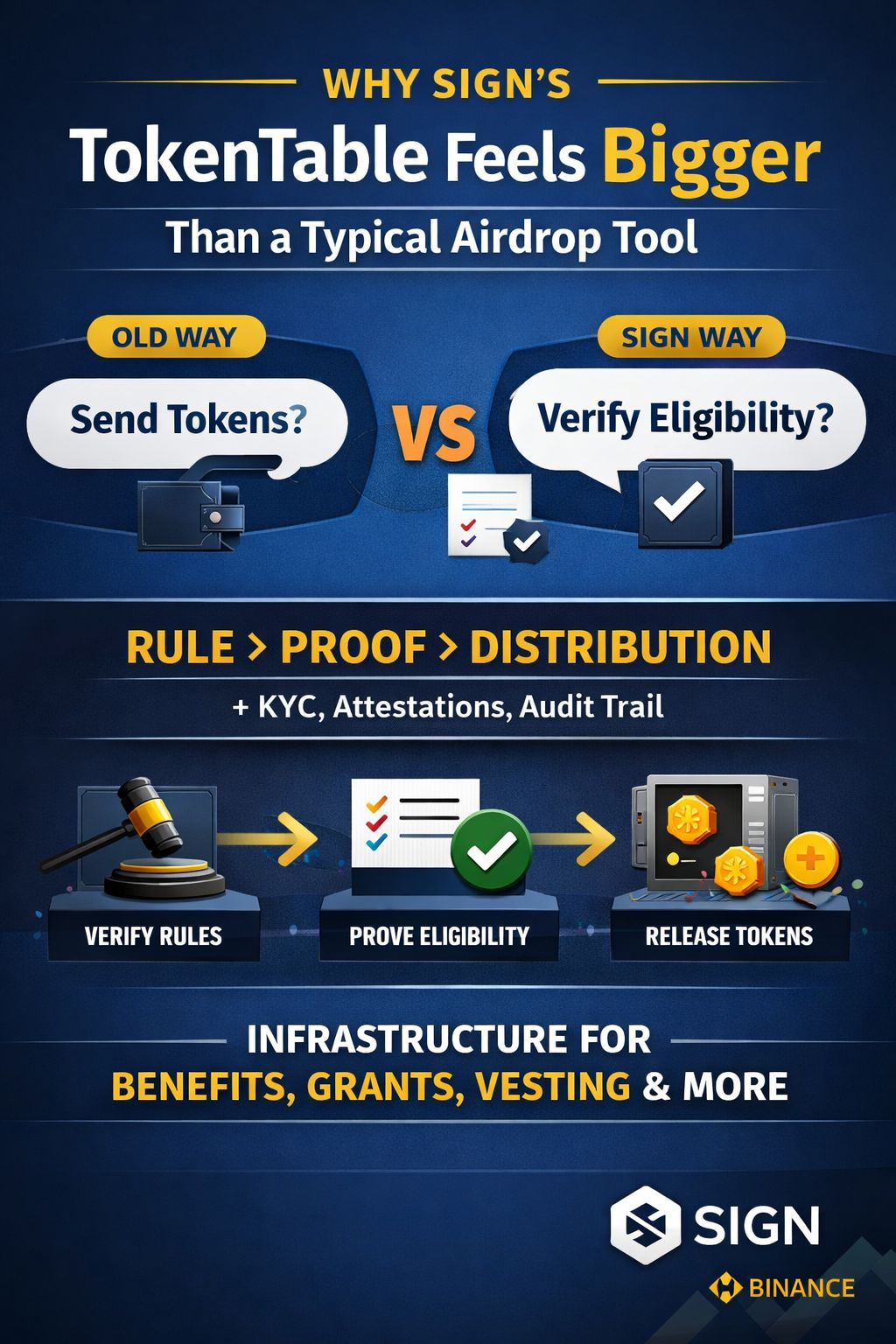
SIGN’s own materials describe TokenTable as a high-throughput distribution system for programmable disbursement, with rules-based scheduling and on-chain auditability. In the broader SIGN stack, it sits next to Sign Protocol, which handles attestations and verification. That pairing matters because it means distribution is not separated from evidence. The system can connect a payout to a condition that was actually checked, not just to a wallet that happened to appear on a list.
I think that changes the emotional center of the whole product.
A normal airdrop tool asks, “How do we get tokens to addresses?”
SIGN asks something more serious: “What has to be true before those addresses are allowed to receive anything?”
That sounds subtle, but it is a big shift.
The clearest example is the ZetaChain case study in SIGN’s docs. There, TokenTable was used with Sign Protocol and Sumsub so claimers above a threshold had to complete KYC, bind that KYC result to their wallet through an attestation, and then let the Unlocker contract validate that attestation before the airdrop could be claimed. In other words, the token did not move first and get justified later. The rule came first. The proof came next. The claim only happened after that.
That sequence is the real insight to me.
It turns distribution from a marketing event into a controlled execution layer.
And once I started seeing it that way, TokenTable stopped looking like “just another token launch product.” It started looking more like infrastructure for benefits, grants, rewards, subsidies, vesting schedules, and any other program where eligibility has to be checked before value is released. SIGN’s MiCA whitepaper leans in that same direction, describing TokenTable as a programmable digital asset disbursement engine with time-based logic, audit-trail storage, and support for benefits or incentives beyond simple token drops.
What I find especially strong here is the architecture behind it.
The docs and whitepaper repeatedly point toward a model where off-chain verification and policy checks can be connected to on-chain execution. Sign Protocol records attestations. TokenTable uses rules and contract logic to decide whether a claim should unlock. That lets a project combine identity checks, compliance filters, vesting, calendar-based release logic, and public auditability in one flow instead of scattering those responsibilities across five disconnected systems.
That kind of design matters more than people think.
In crypto, we often talk about fairness as if it begins and ends with transparency. But transparent unfairness is still unfair. A public wallet list does not solve much if the underlying eligibility logic is weak, arbitrary, or impossible to inspect. What SIGN seems to be building is a way for distribution to become more programmable, conditional, and reviewable. Not perfect. Not magically trustless in every layer. But a lot more structured than the usual “connect wallet and hope the backend is honest” model.
My personal view is that this may be one of the most practical parts of SIGN’s whole stack. Verification becomes much more valuable when it can actually trigger something real. And distribution becomes much more credible when it can show not only who got paid, but why they qualified in the first place.
@SignOfficial #SignDigitalSovereignInfra $SIGN