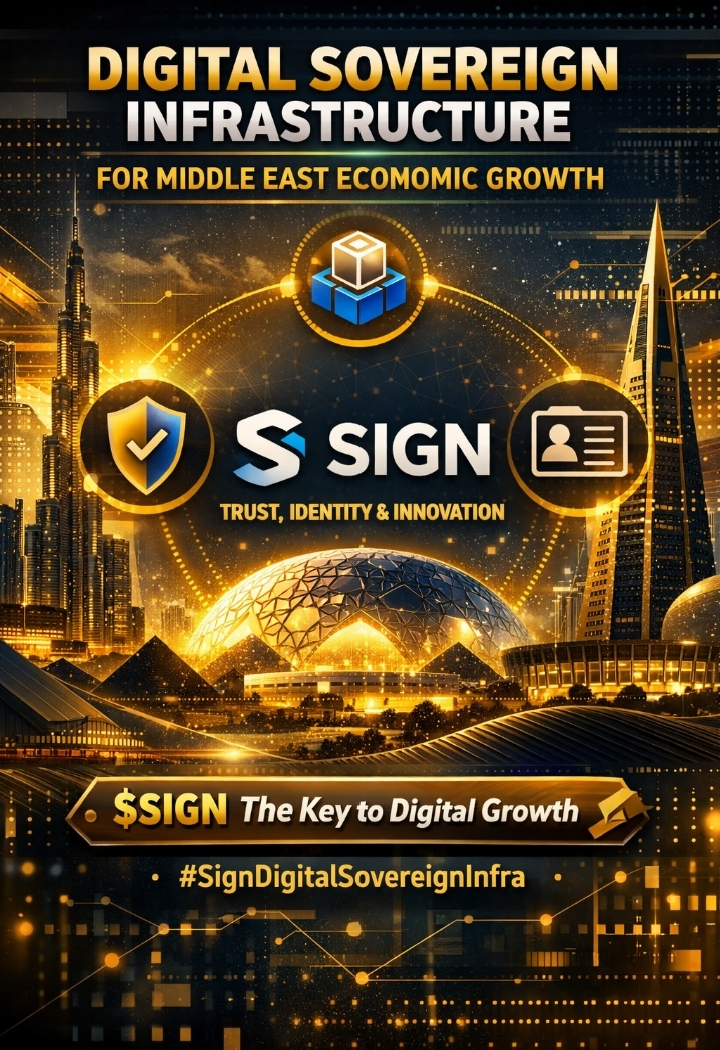
As the Middle East accelerates toward a digitally empowered economy, infrastructure becomes the defining layer of long-term success. This is where @SignOfficial is positioning itself as a powerful catalyst. Rather than being just another blockchain project, Sign is emerging as a digital sovereign infrastructure—a foundational layer designed to support secure, scalable, and trustless interactions across borders, institutions, and governments.
The region is witnessing rapid adoption of digital identity, smart governance, and decentralized finance. However, without a unified and verifiable system of trust, these advancements face fragmentation. Sign addresses this gap by enabling verifiable credentials, cross-chain identity solutions, and cryptographic trust frameworks that align perfectly with the Middle East’s vision for innovation-driven economies.
The $SIGN token plays a critical role within this ecosystem. It powers verification processes, incentivizes participation, and secures the network. As adoption grows, the utility of is expected to expand significantly—especially as governments and enterprises explore sovereign digital infrastructure solutions.
From smart cities in the UAE to fintech expansion in Saudi Arabia, the demand for secure digital frameworks is rising. Sign is not just participating in this transformation—it is helping define it. By bridging Web2 and Web3 identity systems, Sign enables nations to build independent, resilient, and future-ready digital ecosystems.
In my view, the long-term value of lies in its real-world application. Projects focused on infrastructure tend to outperform hype-driven narratives because they solve fundamental problems. If Sign continues to build partnerships and expand its ecosystem, it could become a cornerstone of digital sovereignty not only in the Middle East but globally.#signDataSovereignInfra @SignOfficial $SIGN