
The evolution of digital finance is no longer centered solely on speed or decentralization. Today, the real challenge lies in balancing three critical pillars: efficiency, privacy, and regulatory compliance. Across emerging and developed markets alike, businesses and individuals continue to face friction in cross-border transactions—ranging from delays and excessive fees to increasing compliance burdens and limited financial privacy.
This structural inefficiency is particularly evident in global trade environments. Small and medium-sized enterprises (SMEs), especially in import-export sectors, often encounter prolonged settlement times, inconsistent transaction approvals, and operational uncertainty. At the same time, heightened regulatory scrutiny has made financial systems more secure, yet significantly more complex for end users.
Sign Protocol introduces a forward-looking approach to this challenge through a dual-rail digital money architecture, designed to align the interests of individuals, enterprises, and regulators within a unified framework.
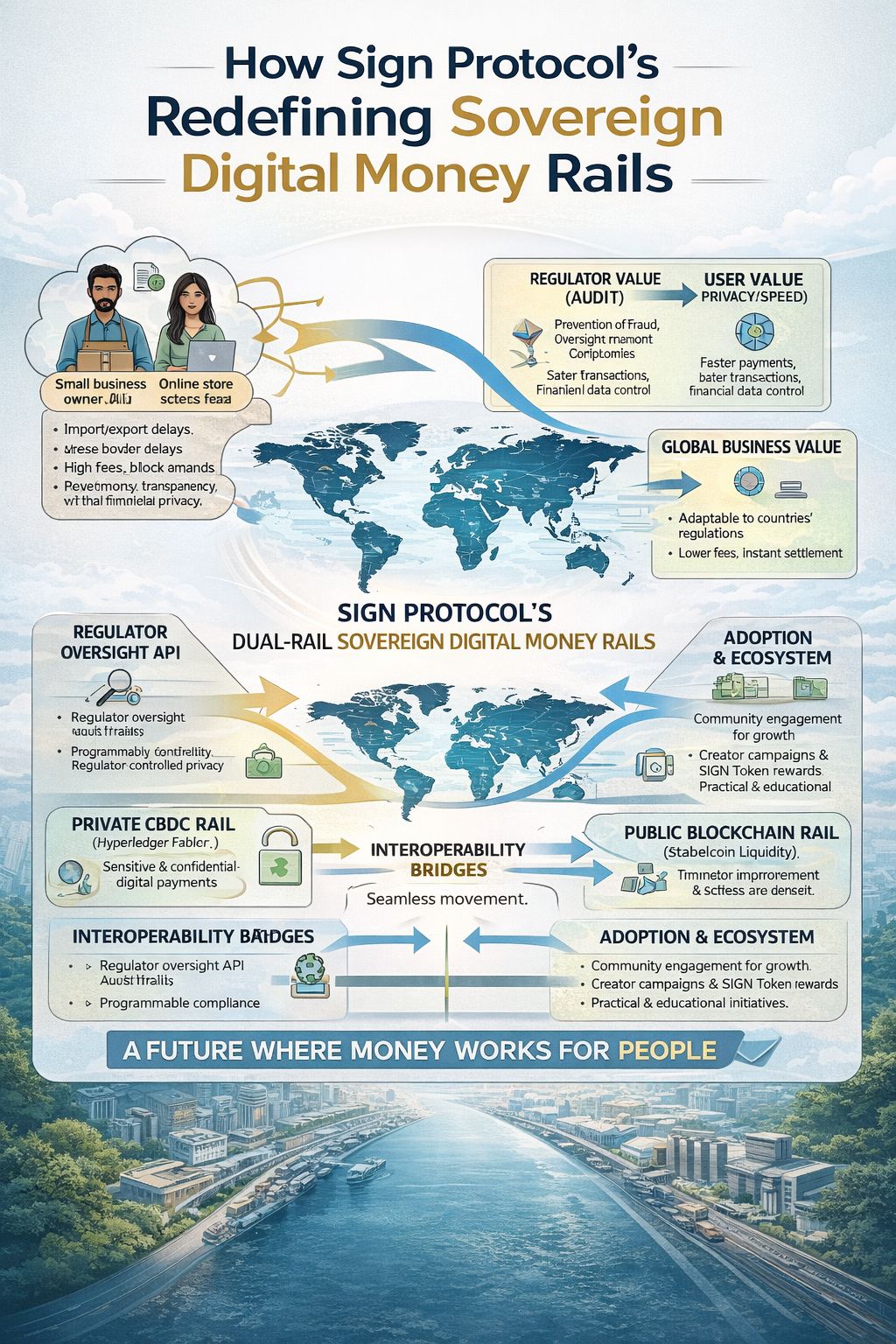
At the core of this system are two interoperable layers:
The private, permissioned rail is optimized for domestic financial activity and sovereign digital currencies. Built on enterprise-grade infrastructure, this layer enables configurable privacy, high transaction throughput, and deterministic finality. Sensitive financial data remains protected within controlled environments, while authorized entities—such as regulators and central banks—retain the ability to audit transactions when required. This ensures compliance without exposing user-level financial details unnecessarily.
Complementing this is the public blockchain rail, which facilitates transparent, borderless, and efficient cross-border transactions. This layer is particularly suited for international trade settlements and liquidity movement, where openness and interoperability are essential.
What differentiates this architecture is the seamless bridging mechanism between the two rails. This interoperability layer allows value to transition fluidly between private sovereign systems and public blockchain networks. In practical terms, a transaction can originate within a secure, private CBDC environment, convert into a globally accessible digital asset for cross-border transmission, and settle on the receiving end with speed and minimal friction—all while preserving user privacy and meeting regulatory standards.
This model effectively resolves one of the most persistent dilemmas in financial infrastructure: the trade-off between transparency and confidentiality. By enabling selective visibility and programmable compliance, the system ensures that oversight does not come at the cost of usability or trust.
From a macroeconomic perspective, such infrastructure has the potential to significantly enhance global financial efficiency. Reduced settlement times, lower transaction costs, and improved liquidity flows can directly benefit businesses engaged in international commerce. For individuals, the impact is equally meaningful—simplified payments, greater control over personal financial data, and reduced dependency on traditional banking bottlenecks.
Additionally, the programmable nature of this system allows it to adapt across jurisdictions, making it highly relevant in a fragmented regulatory landscape. Governments can tailor rules, automate compliance procedures, and integrate monetary policy mechanisms directly into the financial layer.
Beyond infrastructure, ecosystem engagement is also emerging as a key driver of adoption. Initiatives such as creator-focused campaigns and token-based incentives are helping bridge the gap between complex financial technologies and everyday users. This approach fosters awareness, participation, and early-stage network effects, which are critical for long-term scalability.
However, it is important to recognize that such systems are still in the early stages of real-world deployment. Challenges related to interoperability, regulatory harmonization, and institutional adoption remain. Despite this, the direction is clear: the future of money will be programmable, interoperable, and increasingly sovereign.
In conclusion, $SIGN Protocol’s dual-rail framework represents a significant step toward redefining how digital money operates at both national and global levels. By integrating privacy, compliance, and efficiency into a single cohesive system, it offers a practical pathway toward a more inclusive and resilient financial ecosystem—one where money moves seamlessly, securely, and intelligently across borders.#sing @sing