

I’ve been watching this space long enough to notice a pattern—every cycle talks about speed, scale, or narratives. But almost no one talks about verification. Not real verification. The kind that survives outside a single platform, outside a single database, outside a single moment.
That’s where Sign Global starts to feel different.
Not louder. Not trend-driven. Just… structurally different.
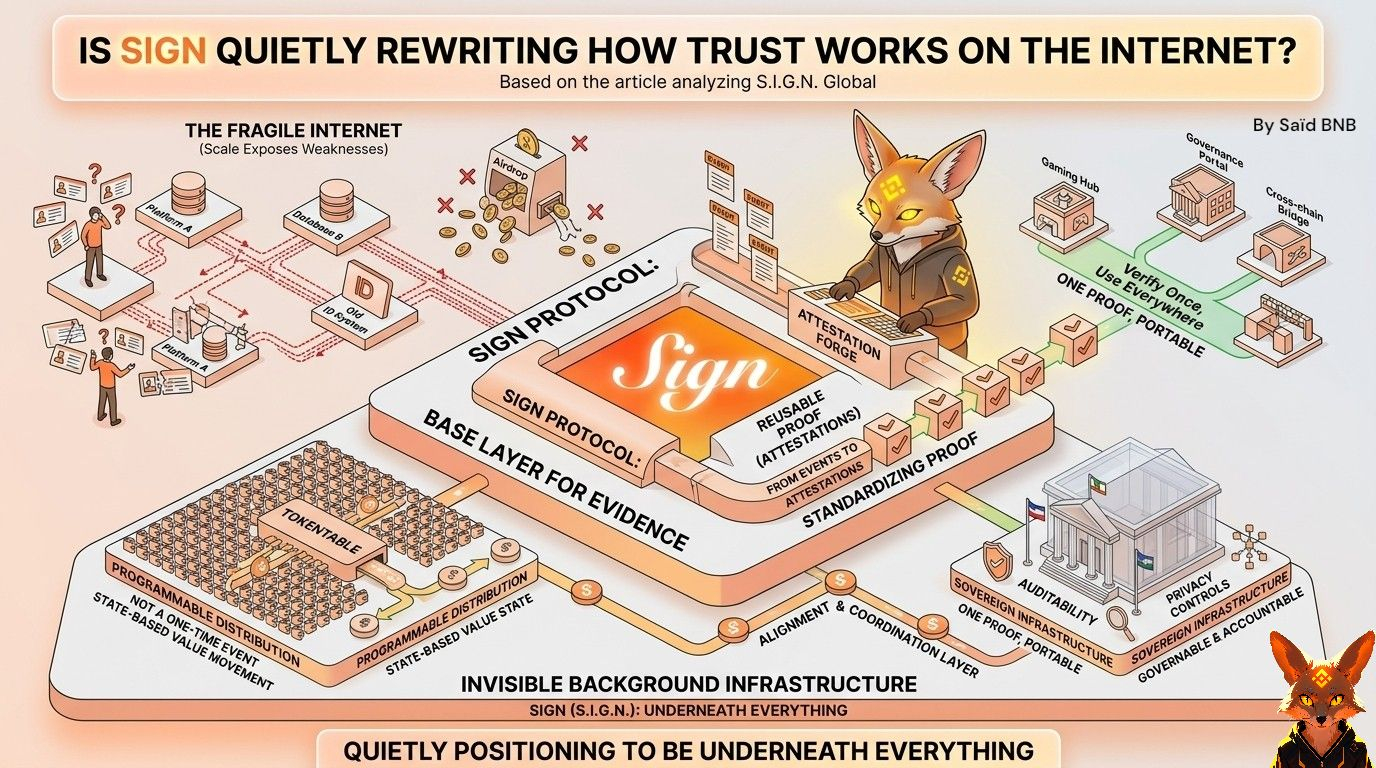
Because if you strip everything down, the internet still runs on introductions. You sign up, you connect a wallet, you get approved, you receive something. But every step depends on someone remembering, storing, or trusting that action happened. It’s fragile. Repetitive. Closed.
Sign doesn’t try to optimize that loop.
It replaces it.
What I see forming around S.I.G.N. isn’t another protocol trying to capture attention. It’s something closer to a base layer for evidence. A system where actions don’t just happen—they get recorded as attestations, turning events into reusable truth.
And that shift is subtle, but it changes everything.
Because once an action becomes an attestation, it stops being local.
It becomes portable.
You don’t need to re-verify identity across platforms. You don’t need to repeat eligibility checks. You don’t need to rely on isolated systems to confirm what already happened. One proof, created once, can be reused across systems that recognize it.
That’s not efficiency.
That’s compression of trust.
And it’s why Sign feels less like an app layer and more like infrastructure trying to disappear into the background.
I keep coming back to one idea: scale exposes weaknesses.
At small scale, broken verification systems are invisible. Manual checks work. Centralized databases hold. Trust assumptions don’t break.
At large scale, everything fractures.
Airdrops become chaotic. Identity becomes fragmented. Distribution becomes inconsistent. Systems start asking the same question again and again because they can’t rely on answers from elsewhere.
Sign is building around that exact breaking point.
Not by adding more logic—but by standardizing proof itself.
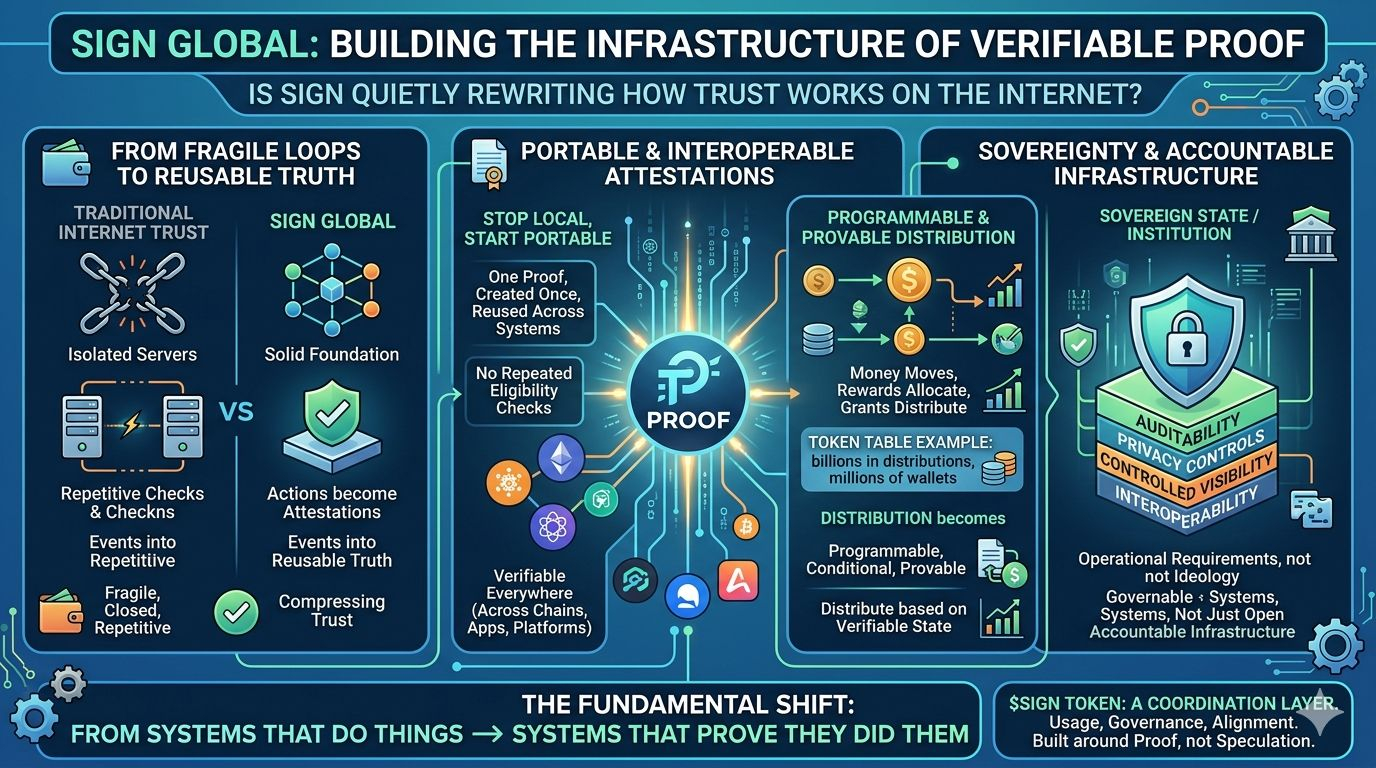
Through Sign Protocol, the system defines a format for attestations that can be created, verified, and reused across chains and applications. It’s not trying to own the data. It’s trying to make the data verifiable everywhere.
That distinction matters more than most realize.
Because ownership without verifiability is still dependency.
Then there’s the part most people miss: distribution.
Everyone talks about identity. Fewer talk about what happens after identity is verified.
Money moves. Rewards get allocated. Grants get distributed. Access gets granted.
This is where Sign quietly built real traction.
TokenTable alone has already handled billions in distributions across tens of millions of wallets. Not as a narrative—but as infrastructure actually used under load.
And when you connect that to attestations, something clicks.
Distribution stops being a one-time event.
It becomes programmable.
Conditional.
Provable.
Instead of “send tokens to a list,” it becomes “distribute value based on verifiable state.”
That’s a completely different system.
Another angle I keep thinking about is sovereignty.
Most crypto projects talk about decentralization as an ideology. Sign approaches it as an operational requirement.
If a nation wants to issue digital identity, distribute benefits, or manage capital flows, it can’t rely on opaque systems. It needs auditability, privacy controls, and interoperability across institutions.
S.I.G.N. is designed with that constraint in mind.
Not just open systems—but governable systems.
Not just transparency—but controlled visibility.
Not just decentralization—but accountable infrastructure.
That’s a different design philosophy from most of the space.
And it explains why Sign doesn’t move like a typical narrative-driven project.
It’s not trying to go viral.
It’s trying to become invisible.
So where does $SIGN fit into this?
Not as a headline.
As alignment.
A coordination layer across a system where attestations, identity, and distribution intersect. It’s tied to usage, governance, and participation inside an ecosystem that’s built around proof, not speculation.
That doesn’t make it simple.
But it makes it coherent.
If I had to reduce everything into one thought, it’s this:
We’ve spent years building systems that do things.
Now we’re starting to build systems that can prove they did them.
That shift is easy to ignore early on.
Until everything depends on it.
And that’s why I keep watching Sign.
Not because it’s everywhere.
But because it’s quietly positioning itself to be underneath everything.