

I don’t even remember what tab I had open before I ended up reading about SIGN. That’s kind of how most of this space works now—one rabbit hole opens into five more, and somewhere between AI agents, restaking layers, and whatever new “modular narrative” is trending this week, you forget what problem we were even trying to solve in the first place.
And that’s been bothering me more than usual lately.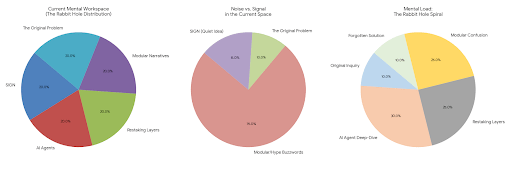
Because if I zoom out for a second, the pattern is painfully obvious. We keep building faster chains, cheaper execution, cleaner abstractions… and somehow the actual experience of using crypto still feels like duct tape over duct tape. Identity is fragmented. Token distribution is messy. “Verification” is still mostly vibes plus screenshots. And every new cycle, we pretend like this time it’s different because we renamed the same problems with better branding.
That’s kind of the headspace I was in when I stumbled into SIGN.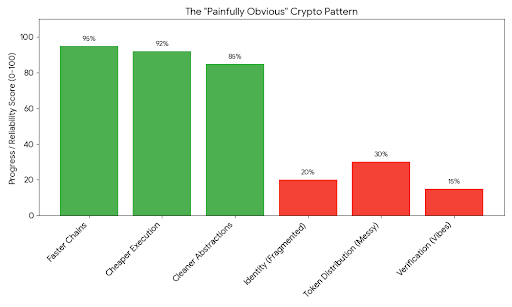
Not because it was loud. It wasn’t. No aggressive marketing, no “this changes everything” energy. If anything, it felt like the opposite. More like someone quietly working on the plumbing while everyone else is arguing about the color of the walls.
And maybe that’s why it stuck with me.
Because the more I look at where things actually break in crypto, it’s rarely the flashy stuff. It’s not the TPS numbers or the consensus mechanism. It’s what happens when real people show up. When distribution matters. When you actually need to prove something about a user, or a wallet, or a history—and suddenly you realize there’s no clean way to do it without reinventing the process every single time.
We don’t talk about that enough.
We talk about scaling like it’s just a technical constraint, but adoption breaks systems in much more boring ways. A campaign goes viral, and suddenly the infrastructure behind it can’t handle verification. A token launch attracts attention, and distribution turns into chaos because nobody has a standardized way to decide who gets what. Sybil attacks aren’t some edge case—they’re the default environment.
And what do we do? We patch it.
Always patching.
One-off allowlists. Custom scripts. Off-chain spreadsheets pretending to be “systems.” It works just enough to get through the moment, and then we move on and call it innovation.
So when something like SIGN shows up, focusing specifically on credential verification and token distribution, my first instinct isn’t excitement. It’s skepticism. Because we’ve seen this before. Everyone claims to fix identity. Everyone claims to solve trust.
But the difference here, at least from what I can tell so far, is that SIGN isn’t trying to turn identity into some grand philosophical layer. It’s treating it like infrastructure. Like something that should just work, quietly, across different use cases, without needing to be reinvented every time someone launches a campaign or builds a product.
And that framing matters more than people think.
Because right now, “proof” in crypto is weirdly incomplete. You can prove ownership of assets. You can prove transaction history. But the moment you step into anything involving human context—credentials, reputation, eligibility—it gets messy fast. Either you rely on centralized systems, or you build fragile, custom solutions that don’t scale beyond your specific use case.
SIGN seems to be leaning into that gap.
Not by overcomplicating it, but by standardizing it. Creating a system where credentials—whether it’s participation in a campaign, contribution to a project, or eligibility for a distribution—can be issued, verified, and reused across contexts.
At least, that’s the idea.
And if it works the way it’s supposed to, it could remove a lot of the friction we’ve just accepted as normal. Projects wouldn’t need to rebuild verification logic from scratch. Users wouldn’t need to constantly prove themselves in slightly different ways across different platforms. Distribution could become less chaotic, less dependent on ad hoc decisions.
But then again, that’s the optimistic version.
The more realistic version is… people are lazy.
Not in a negative way. Just in a human way. Most users don’t care about better infrastructure. They care about outcomes. If the current messy system kind of works, even if it’s inefficient, there’s very little incentive to switch unless the improvement is obvious and immediate.
And that’s where a lot of “infrastructure” projects quietly die.
Not because they’re wrong, but because they’re early. Or invisible. Or too dependent on other people adopting them first.
SIGN sits right in that uncomfortable zone.
Because it’s not a product you can easily show off. It’s not something that creates hype on its own. Its value only becomes clear when enough projects start using it, when enough credentials exist, when the network effect kicks in.
Until then, it’s just… potential.
And crypto is notoriously bad at waiting for potential to mature.
We’ve trained ourselves to chase narratives that can be explained in a tweet. AI agents trading on your behalf. Fully autonomous DAOs. Infinite scalability. Those ideas are easy to sell, even if they’re half-baked. But something like standardized credential infrastructure? That’s a harder story. It requires patience. And coordination. Two things this space doesn’t exactly excel at.
Still, I can’t ignore the timing.
Because underneath all the noise, there’s a shift happening. More projects are realizing that distribution matters more than launch. That who gets tokens, and why, and how it’s verified… that’s not a side detail. It’s the foundation of everything that comes after.
We’ve already seen what happens when that foundation is weak. Airdrops get farmed. Communities get diluted. Incentives get misaligned. And then everyone acts surprised when engagement disappears the moment rewards dry up.
It’s not surprising. It’s predictable.
And that’s the part where something like SIGN starts to feel less optional and more… necessary. Not in a dramatic way. Just in a quiet, structural way. Like something that, if it existed earlier, might have prevented a lot of the inefficiencies we now just accept as part of the game.
But necessity doesn’t guarantee adoption.
There are already other players trying to touch similar areas—identity layers, reputation systems, on-chain credentials. Some are more focused on privacy, others on composability, others on governance. The space isn’t empty. And that means SIGN isn’t just solving a problem; it’s competing for attention in a market that’s already fragmented.
And fragmentation is its own kind of gravity.
Even if SIGN builds something technically solid, it still has to convince projects to integrate it instead of rolling their own solutions. It has to convince users that their credentials are worth maintaining, that this layer is worth engaging with. It has to navigate the usual crypto dynamics—speculation, short-term incentives, shifting narratives—while trying to build something that only proves its value over time.
That’s not easy.
Especially when liquidity drives attention more than utility does. Let’s be honest about that. A project can have perfect infrastructure, but if there’s no capital, no trading volume, no immediate upside, it struggles to stay relevant. Meanwhile, something half-functional can dominate the conversation just because it’s financially attractive in the short term.
So where does that leave something like SIGN?
Somewhere in between.
Not flashy enough to ride hype alone. Not simple enough to ignore the complexity of what it’s trying to fix. But also not meaningless. If anything, it feels like one of those pieces that only becomes obvious in hindsight—if it works.
And that “if” is doing a lot of work.
Because the real test isn’t whether SIGN can build the infrastructure. It’s whether anyone actually uses it at scale. Whether projects trust it enough to rely on it. Whether users interact with it without friction. Whether it can survive the usual cycles of attention and neglect that define this space.
I don’t have a clean answer to that.
Part of me thinks we’re moving toward a point where this kind of infrastructure becomes unavoidable. Where the cost of not having standardized verification and distribution becomes too high to ignore. Where the industry finally gets tired of improvising the same solutions over and over again.
And part of me thinks we’ll just keep patching things until the next narrative distracts us.
That’s the tension I can’t shake.
SIGN makes sense on paper. It even makes sense in practice, from what I’ve seen so far. But crypto isn’t a place where “making sense” is enough. Timing, incentives, attention—those matter just as much, if not more.
So yeah, I’m watching it.
Not with blind optimism. Not with dismissal either. Just… watching. Trying to see if it quietly integrates into the background of everything, or if it ends up as another well-built system that never quite reaches critical mass.
Because at the end of the day, that’s what this comes down to.
Not whether SIGN is right.
But whether the rest of the space is ready to admit it needs something like this.
It might click. It might become invisible infrastructure that everything depends on without thinking about it.
Or it just sits there, technically sound, waiting for an industry that never slows down long enough to use it.