Why Sign Protocol’s ZK-Powered Revocable Attestations Could Actually Fix How Countries Handle Welfare
Hey Square fam,
I’ve been going deep on infrastructure projects lately, and honestly, something with Sign Protocol $SIGN just hit different. This isn’t another DeFi farming narrative or some random meme coin play. It feels like real sovereign-grade tech that could actually solve one of the biggest headaches governments have: making welfare systems dynamic, fair, and efficient instead of the slow, broken mess they usually are.
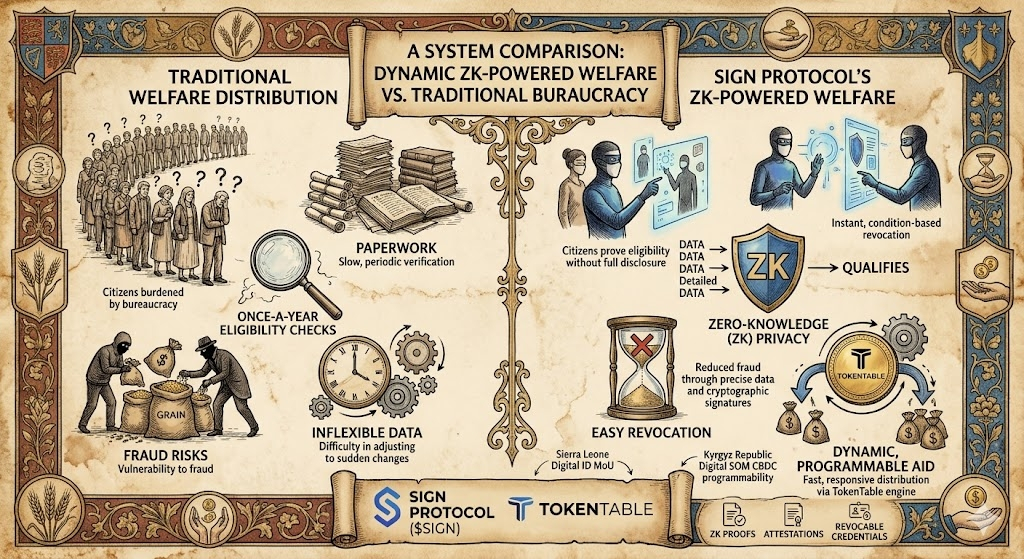
Let me paint the picture. Traditional welfare programs are painful. You fill out forms once a year (if you’re lucky), eligibility gets checked in slow bureaucratic waves, and fraud sneaks through the cracks constantly. When someone’s life changes — they lose their job, face a medical emergency, or their family situation shifts — the system barely reacts. Either money keeps flowing to people who no longer need it, or worse, it takes forever to reach the ones who suddenly do. In many developing countries, this isn’t just inefficiency. It’s families going without food or basic support while paperwork crawls through the system.
That’s where Sign Protocol comes in. It’s basically an omni-chain attestation layer think of it as a supercharged digital notary that governments and official agencies can actually use. Authorized issuers (ministries, local departments, even verified NGOs) can create structured, cryptographically signed “attestations.” These are like official claims tied to clear schemas (reusable templates) that say things like: “This person qualifies for support type X as of this date, based on condition Y.”
What makes it powerful for welfare are two things that really stand out: Zero-Knowledge proofs and built-in revocation.
First, the ZK privacy angle is actually useful, not just marketing fluff.
With ZK, a citizen can prove they meet the criteria for aid without exposing their entire personal life on-chain. For example:
Prove their income is below a certain threshold
Prove they live in a specific flood-affected area
Prove they have kids under 18 who depend on them
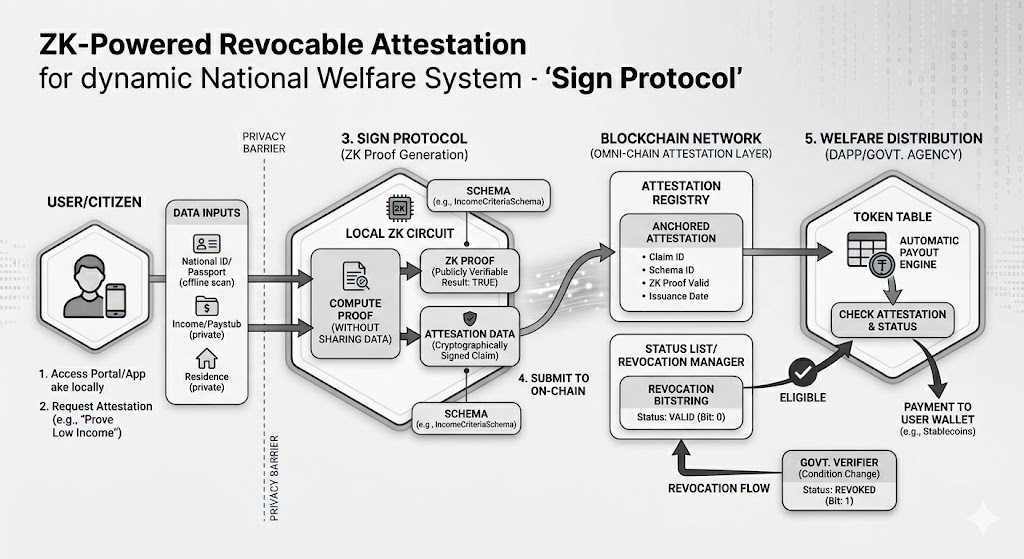
All of this without revealing exact salary numbers, home address, or sensitive health info. The proof gets generated right on the user’s phone or device (using something like a passport scan + ZK circuit), and only the verification result gets recorded. Governments get the auditability they need while staying compliant with privacy laws. Citizens get to keep their data private instead of it sitting in some vulnerable central database that gets hacked every other year.
Sign’s setup lets developers bake these ZK rules directly into schemas. So you can enforce “only allow this if the person is over 18 via ZK proof” without anyone ever seeing the raw data. This lines up perfectly with countries that are building digital ID systems alongside welfare programs. We’re already seeing early signals in places that are serious about financial inclusion.
Now, here’s the part that really changes the game: revocable and dynamic attestations.
Life doesn’t stay static. A person might qualify for unemployment benefits today but get a job next month. Traditional systems struggle with that. Sign Protocol has native support for revocation and expiration built right in.
An attestation for jobless support can be time-limited or tied to conditions. If the person finds work, the labor ministry can revoke it instantly through an on-chain status list. No chasing people down, no delayed overpayments. For seasonal help like support for farmers during harvest season or heating subsidies in winter the attestation can simply expire after a few months.
This pairs beautifully with TokenTable, Sign’s programmable distribution tool. Once the eligibility attestation is there, funds (stablecoins or even CBDC) can flow automatically and directly to the right wallet. No middlemen taking cuts, no weeks of delays.
Picture a national welfare system working like this:
Citizen applies or gets automatically flagged through their digital ID.
Government verifier issues a ZK-backed attestation confirming they qualify.
TokenTable reads that live attestation and triggers the payout.
If something changes, one simple revocation updates the whole chain future payments stop automatically.
This isn’t some far-future fantasy. Sign’s docs and whitepaper lay out exactly this stack: new digital ID system for identity - Sign Protocol for attestations and evidence -TokenTable for actual money movement. They’ve already proven they can handle billions in Web3 distributions. Now they’re applying the same logic to real government use cases — pensions, emergency relief, agricultural subsidies, you name it.
There’s real momentum building, not just hype.
Sierra Leone signed an MoU with the Sign Foundation focused on national digital identity, blockchain-based payments, and asset tokenization. That’s the exact foundation needed to make welfare more transparent in a country where identity gaps leave millions outside the subsidy net. In the Kyrgyz Republic, they have a technical agreement with the National Bank around Digital SOM (their CBDC project) that includes programmable money features — which could easily route aid based on verified, up-to-date needs.
These aren’t just vague talks. They’re heading toward actual pilots where attestations become the backbone for public benefits, with ZK keeping things private and revocation keeping everything current. Other reports mention using similar setups for unemployment benefits, student stipends, healthcare subsidies — all delivered precisely, quickly, and with proper audit trails.
Compare that to how things work in most countries right now:
Repeated KYC-style checks that waste everyone’s time and money
Fraud rates that can reach 10-20% because verification is slow and disconnected
Emergency aid during floods, droughts or economic crises that takes weeks or months to organize because data isn’t dynamic
With Sign’s approach, a government could create a one-time schema for “disaster impact attestation,” let local officers on the ground issue ZK proofs, and get money moving in hours instead of months. Even in rural areas with spotty internet, efficient revocation lists (using bitstring status lists) allow offline verification.
For $SIGN itself, this matters a lot. The token isn’t just along for the ride — it powers incentives, staking for attesters, governance, and overall network security. As more real-world attestations get issued (and we’re already seeing traction in pilots), actual utility demand for SIGN should grow. More national systems mean more schemas, more attestations being created and verified, and more distributions flowing through the ecosystem.
To me, this feels like the missing “prove once, use everywhere” infrastructure layer that Web3 has needed for serious real-world adoption. It’s not about replacing governments. It’s about giving them better tools — tools that are more efficient, more transparent, and actually respect privacy.
For people in emerging economies, it could mean welfare that actually adapts to real life instead of working against it.
Of course, it won’t be easy. There are real challenges ahead — slow government adoption timelines, integrating with old legacy systems, making sure the right people are issuing attestations, and scaling ZK tech for millions of users. But the architecture looks solid: it works across public L2s and private sovereign chains, supports hybrid on/off-chain storage, and has strong revocation/expiration features.
I’ve watched too many projects talk big about “real utility” but end up stuck in endless token speculation. Sign Protocol feels different because it’s building the actual evidence layer that makes programmable money useful for public good. Dynamic welfare is just one big use case. You can extend this to e-visas, land records, health credentials, even verifying AI agents against real human attestations. But welfare hits close to home for so many people.
What do you guys think, Square?
Could ZK proofs + revocable attestations finally make government welfare systems fast, adaptive, and fraud-resistant? Which country do you think might adopt something like this first — maybe for seasonal farmer support or emergency disaster relief?
Or am I getting too excited about the infrastructure side?
Drop your honest thoughts below. Let’s talk without the usual hype noise.
@SignOfficial $SIGN #SignDigitalSovereignInfra #Web3