
I never thought about it this way.
I used to believe the issue was slow verification, complicated logins, or too many steps.
But over time, I realized I was looking at the wrong problem entirely.
I don’t struggle with “how to prove”…
I struggle because the proof itself isn’t mine.
Where is the flaw we never noticed?
We don’t start from zero because systems are bad,
we start from zero because every system wants to trust you in its own way.
Every time:
You re-enter your data
You re-upload your documents
You rebuild your “trust” from scratch
As if your digital history… doesn’t move with you.
So the real question becomes:
Why isn’t trust transferable… the way data is?
The moment everything shifted
When I came across Sign Protocol, it didn’t feel like a technical solution,
it felt like it was addressing the root issue:
You don’t need more data… you need to own your proof.
It’s not about showing everything,
it’s about proving just enough.
What does that actually look like?
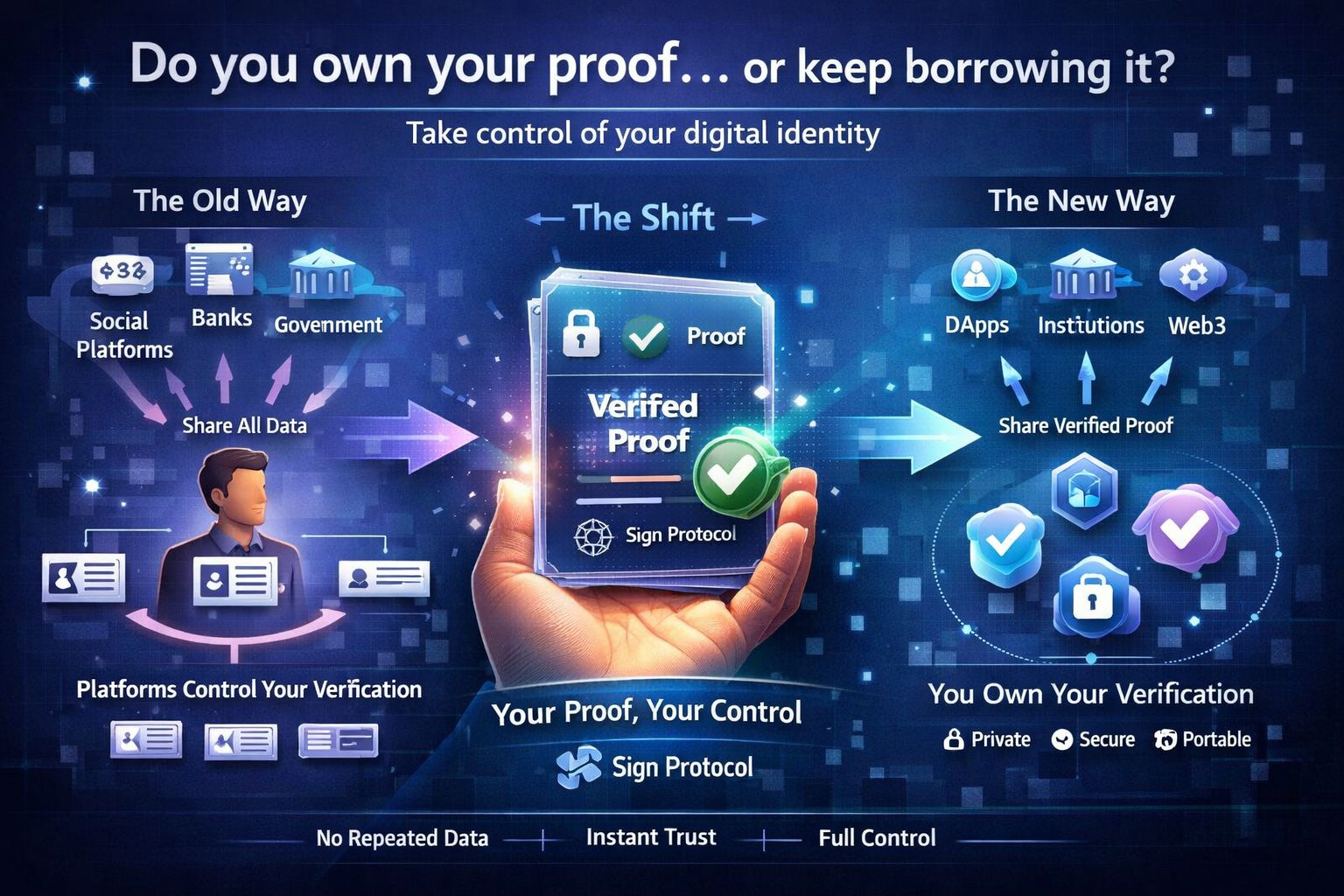
Instead of giving every platform all your information,
you simply provide:
A single, precise proof
Cryptographically signed
Instantly verifiable
Without revealing extra details
You’re not sharing your data…
you’re sharing its verified outcome.
Why does this shift matter?
Because we move from:
“Platforms control your verification”
To:
“You own your proof… platforms just verify it.”
That’s a fundamental shift.
What makes this realistic?
It doesn’t try to replace existing systems.
It doesn’t force the world to restart.
It simply adds a new layer:
A layer where trust becomes portable.
Across:
Platforms
Institutions
Even different chains
What changed for me?
Verification is no longer a burden.
It’s an asset.
I’m no longer trying to prove myself…
I’m using what already proves me.
The takeaway
The problem was never “how to prove”
but who owns the proof
And in the end, the real question is no longer:
“Will this platform trust me?”
But:
“Do I own the proof… or am I still asking for it every time?”
#SignDigitalSovereignInfra @SignOfficial
