Sign Protocol really does feel like one of those projects that might actually stick around for the right reasons. The whole pitch is straightforward—no over-the-top memes, no recycled “we’re decentralizing the world” fluff that everyone tunes out after a few weeks. It’s just clean talk about attestations, verifiable claims, and building this quiet layer for recording what actually happened. Proof, identity, trust stuff that doesn’t scream for attention. I read it and thought, huh, this one feels… different. Like it might be solving something real instead of chasing the next hype cycle.
I’ve been around long enough to recognize the pattern, though.
Every bull run ends with the loud, cartoonish stuff blowing up and disappearing. Then comes the quieter wave—the projects with better branding, tighter docs, and that calm “we’re not like the others” vibe. Suddenly everyone on the timeline starts treating them like the grown-ups in the room. Sign Protocol slots right into that spot. It doesn’t beg for likes or retweets. It just sits there looking solid, like the thing we’ve all secretly been hoping would show up.
And honestly, the core idea isn’t dumb at all. That’s what keeps dragging me back in. A system where you can issue and check attestations—credentials, actions, relationships, whatever—actually fills a real gap. In a space full of unverified noise and broken promises, being able to prove “this happened, here’s the record, go verify it yourself” feels genuinely useful. No smoke and mirrors. It clicks the second you hear it.
But here’s where my gut starts to twist a little.
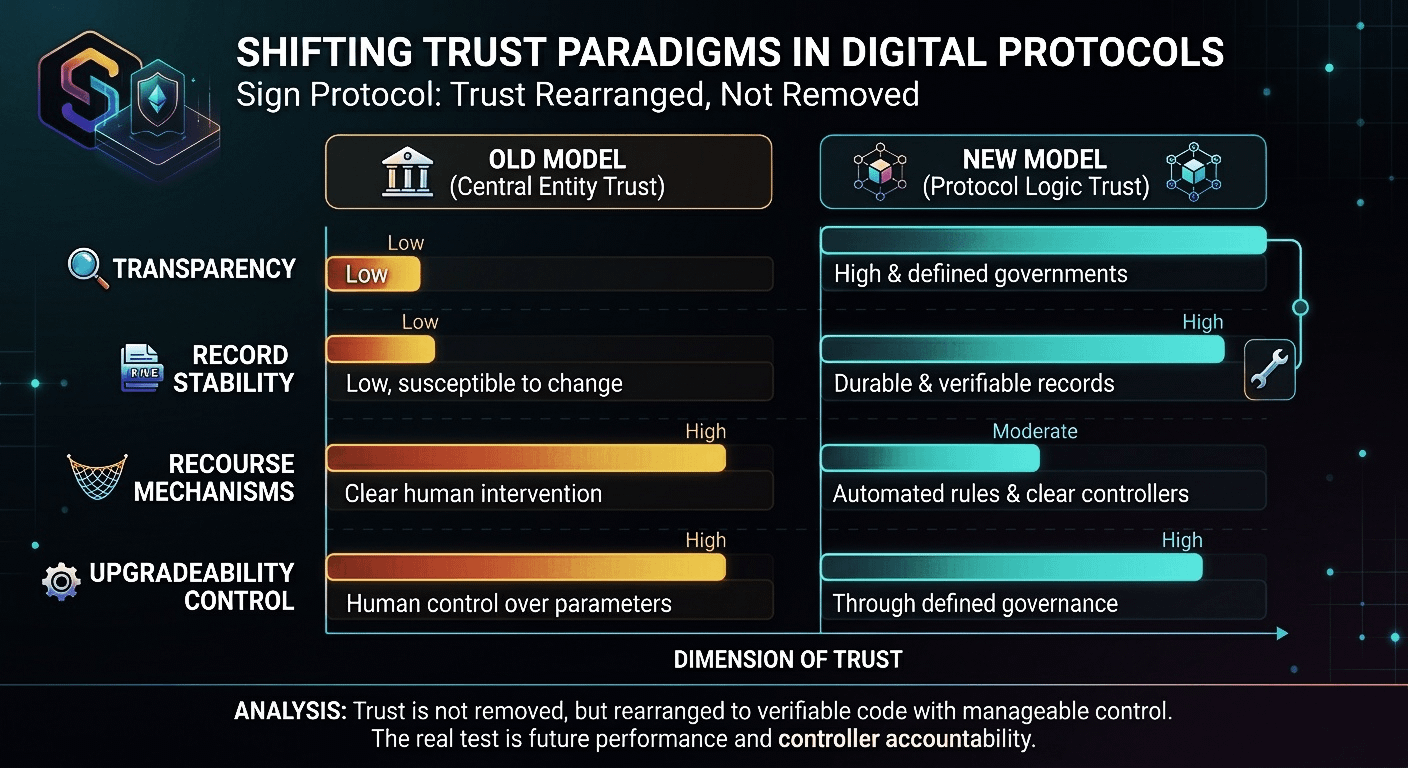
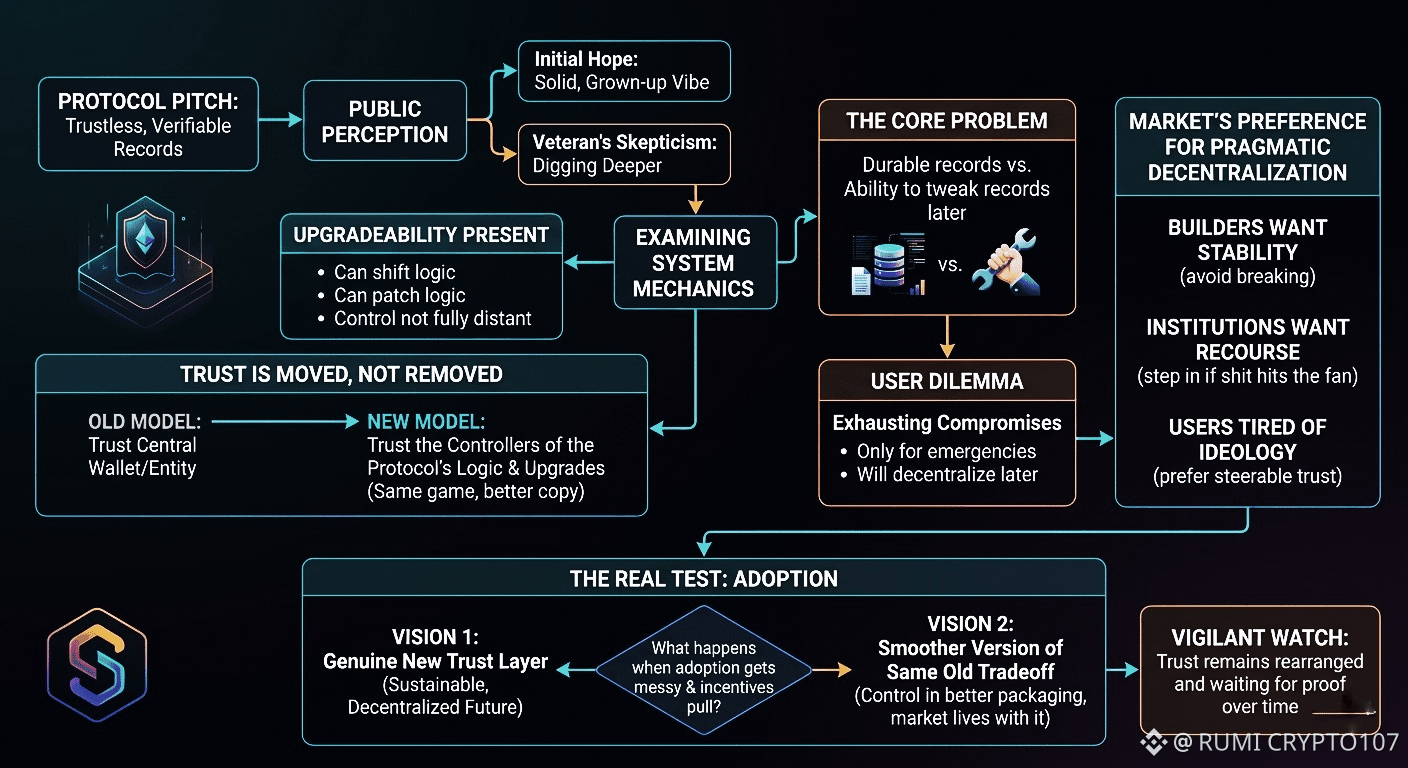
We all hear the word “protocol” and picture something rock-solid, almost untouchable. Code that follows rules instead of whoever happens to hold the keys this week. That dream has been around forever in crypto, even after we’ve gotten burned enough times to know better. Sign talks a great game about trust and verification, but when you dig into how it actually works, the upgradeability is still right there. The rails can shift. The logic can get patched. The hand on the wheel never fully steps away.
Look, I’m not some purity-maxing idealist yelling that every project should launch as an immutable stone tablet and never change. Real life happens—bugs pop up, teams need room to fix things, products evolve. That’s normal. But let’s be straight about it: keeping that upgrade power alive doesn’t remove trust. It just moves it somewhere else. You’re not trusting some obvious centralized wallet anymore. You’re trusting the people who can still rewrite the rules under your feet. Same old game, just with nicer lighting and better copy.
That part hits harder with Sign because the entire thing is built around proof. If you’re selling durable, verifiable records as your main value, then the question of “who can still tweak those records later?” isn’t some side note. It’s front and center. You can’t bury it under pretty docs and thoughtful whitepapers forever.
What really tires me out isn’t that Sign feels fake. The obvious scams are easy—you spot them, roll your eyes, and move on. What gets exhausting are the ones that feel almost right. The ones that make the usual compromises sound reasonable again. “It’s only for emergencies.” “We’ll decentralize it later.” “The market needs flexibility.” I’ve watched those lines do heavy lifting for years while the control quietly becomes permanent.
And here’s the part that’s a little uncomfortable to admit: the market might actually like it this way.
Most builders don’t want something that breaks the second things get messy. If institutions ever wander in, they’ll want proof without losing the ability to step in when shit hits the fan. A lot of us are just tired—tired of pure ideology that ends in rug pulls. We’d rather have trust we can see, understand, and steer if we need to. Sign feels built exactly for that crowd: open enough to feel legit, governed enough to feel safe.
That’s not a flaw. That might actually be the selling point.
I’m not angry about it. Crypto’s taken enough beatings that plenty of people would happily swap the old sermons about purity for something that works when the pressure’s on. I get it. But I also can’t pretend this is the same as control finally disappearing. It’s just control that got better at dressing up and speaking in full sentences.
So I keep watching Sign the way you’d watch someone who seems solid but still keeps one hand tucked behind their back. Not because I expect a rug tomorrow, but because the real story never shows up in the launch narrative. It shows up later—when adoption gets ugly, when incentives start pulling in opposite directions, when someone has to make a tough call that bends the original vision. That’s the moment we’ll find out if this is a genuine new trust layer or just a smoother, more comfortable version of the same old tradeoff—one the market has finally learned to live with.
I really hope it’s the first one. I do. But after this many cycles, I’ve learned to keep the excitement on a short leash and the skepticism fully loaded. Sign has earned more of my attention than most projects. Just not a blind pass.