
I've been glued to the SIGN chart for weeks now, going back and forth in my head about whether I'm onto something real or just doing what I always tell others not to do getting attached to the story while the price keeps whispering that maybe it's not there yet.
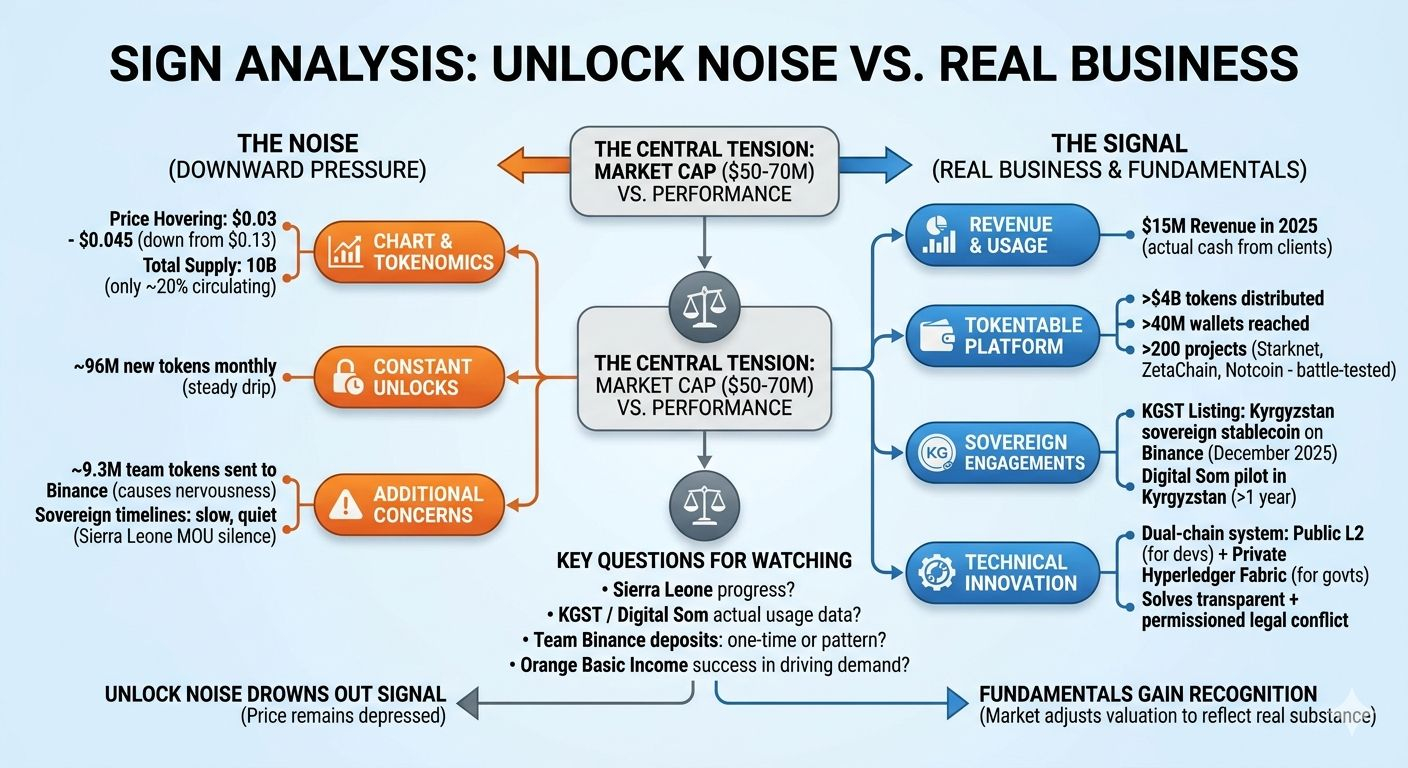
The numbers on the surface aren't pretty. The token is hovering between three and four and a half cents after reaching thirteen cents last September. That's a rough drawdown. Only about a fifth of the 10 billion total supply is circulating, and there's this steady drip of around 96 million new tokens unlocking every month. If I stumbled on this chart with fresh eyes and no backstory, I'd probably just keep scrolling. Honestly, I almost did.
But every time I tried to move on, something pulled me back. Under all the orange branding, airdrop hangover, and unlock anxiety, there's an actual business doing real work. Their TokenTable platform has already facilitated over four billion dollars in token distributions, reaching more than forty million wallets across two hundred-plus projects. We're talking serious names like Starknet, ZetaChain, and Notcoin some of the biggest distribution events crypto has seen lately and the system didn't buckle. That kind of quiet, battle-tested infrastructure matters more than people give it credit for.
What really makes me pause is the revenue. TokenTable brought in about fifteen million dollars last year. Not "if everything goes right" numbers actual cash from clients paying for a real service. With the market cap floating between fifty and seventy million, you're looking at roughly three to five times revenue for a B2B infrastructure play that has solid positioning and not much real competition at this scale. In pretty much any other industry, a software business moving fifteen million a year with four billion in cumulative volume wouldn't be sitting at anywhere near this valuation. Crypto seems to be pricing in almost nothing except the unlock overhang, and I suspect that might be the wrong thing to focus on.
I used to roll my eyes at the government stuff. Too many projects drop flashy MOUs with countries, the price pops for a bit, and then nothing ever ships. I had quietly put Sign's Kyrgyzstan and Sierra Leone announcements in that "probably vapor" folder. Then December 2025 happened: Binance listed KGST, Kyrgyzstan's sovereign stablecoin built directly on Sign's infrastructure. A government-issued token cleared Binance's compliance team and landed a spot listing on the biggest exchange. That’s not something you get if the tech doesn’t actually work. Whatever ends up happening with Kyrgyzstan’s broader Digital Som program, the listing proved the rails are live, a real country used them, and the instrument is trading. The market barely flinched because unlocks were dominating the conversation, but that disconnect has stayed with me.
The tech setup is quietly impressive too, though nobody seems to talk about it much. Sign runs a dual-chain system: a public Layer 2 for all the DeFi-friendly transparent stuff developers actually want, sitting next to a private Hyperledger Fabric chain for governments and central banks that legally can’t put sensitive national data on a public blockchain. A lot of projects chasing sovereign deals hit the same wall public chains scare regulators, fully permissioned ones kill composability. Sign found a way to do both, and they already have live deployments showing it works in practice. Building that combo from scratch while also earning years of trust with governments isn’t something a newcomer could copy overnight.
Of course, I’m not ignoring the red flags. Late last year the team sent around 9.3 million dollars worth of tokens to Binance on-chain. Those kinds of wallet moves usually make people nervous, and for good reason. There could be innocent explanations liquidity, market making, OTC but if it turns into a regular thing while unlocks keep coming, it starts feeling misaligned with holders who bought the infrastructure story. That kind of thing can wear down conviction pretty quickly.
Then there’s the reality of how slowly governments actually move. Sierra Leone signed an MOU in November 2025 and things have been pretty quiet on the technical side since. Kyrgyzstan’s Digital Som has been in pilot for over a year now. Budget shifts, political changes, or expanding compliance rules can drag these projects out or change them completely. The KGST listing at least showed one tangible delivery, but these sovereign timelines don’t care about token unlocks or retail patience.
Still, what keeps me coming back is how rare this setup feels at this market cap. At fifty to seventy million, most tokens are basically just narrative bets hoping the next hot theme carries them without much underneath. SIGN actually generates fifteen million a year, has moved four billion in real distributions, has multiple live government engagements, and built a dual-chain architecture that solves a problem most projects pretend doesn’t exist. Their Orange Basic Income program, sending tokens to actual holders instead of yield farmers, feels like a more honest attempt at building real demand than the usual gimmicks.
I have no idea if this thing wakes up in the next six months or if I’m sitting here two years early, watching unlocks grind the price while I wait for government traction that may or may not come through. What I do know is that fifteen million in real revenue at three-to-five times on a fifty-million market cap deserves a much closer look than most people are giving it after glancing at the chart and writing it off.
I’ll be watching for real progress on Sierra Leone, actual usage data from the Digital Som, and most critically whether those team wallet deposits to Binance were a one-time thing or the start of a pattern. If the government side keeps delivering concrete milestones like the KGST listing, and the team stays disciplined, I think a lot of folks might eventually look back at these prices and wonder why the unlock noise drowned out the signal.
That’s where my head’s at right now. I could be totally wrong. But I’d rather take a shot on something with this much real substance behind it than chase another shiny narrative that falls apart the moment you dig in. The gap between what they’ve already built and what the market is pricing feels big enough to keep me paying attention.
@SignOfficial #SignDigitalSovereignInfra
