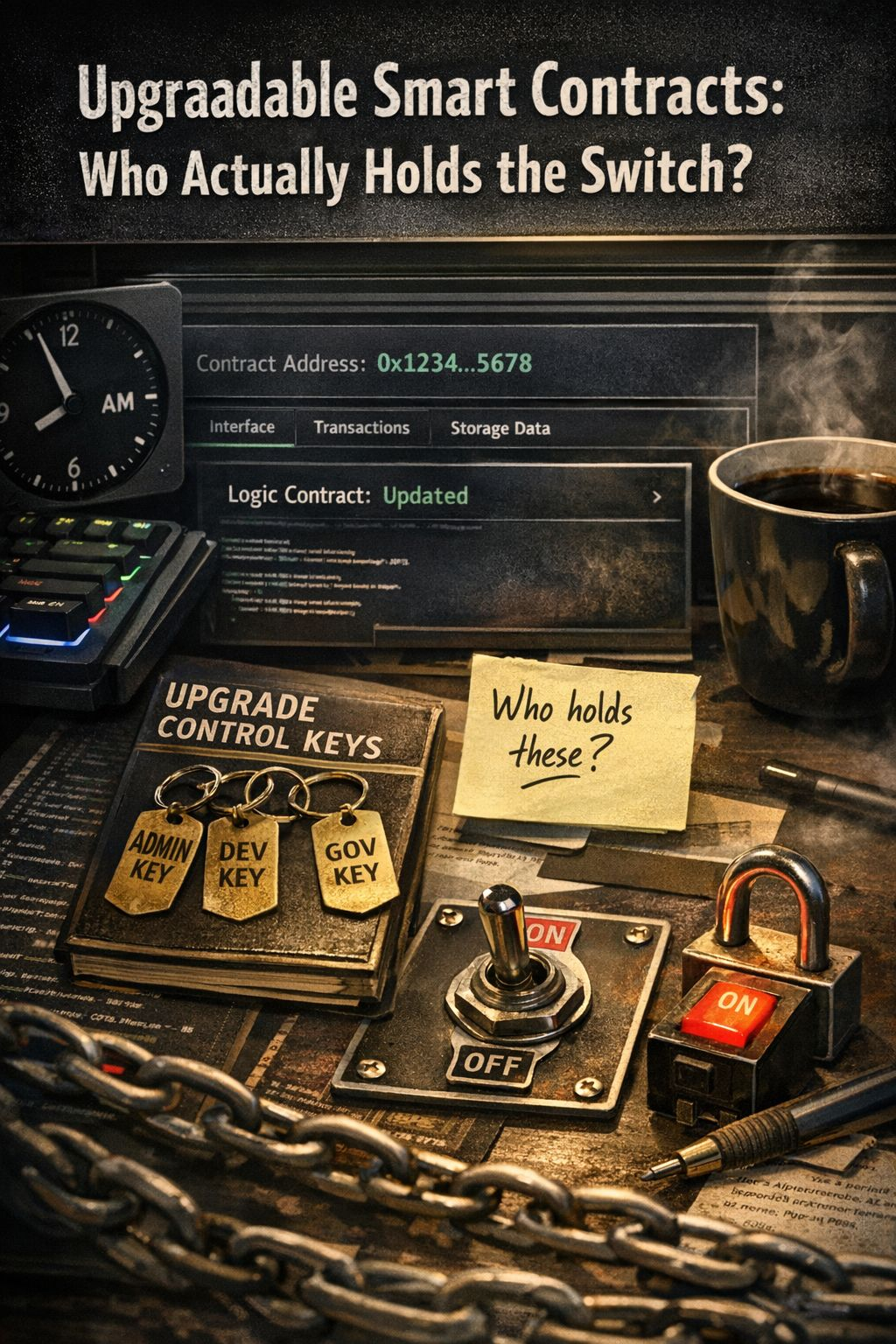
There’s a quiet detail most people miss the first dozen times they use a dApp.The address doesn’t change.You bookmark it, maybe even memorize part of it. Same interface, same buttons, same expected result. It feels… anchored. Reliable in that very specific on-chain way.
But that feeling isn’t the system. It’s just the surface.
—
Late one night — around AM, screen $SIGN brightness too high, everything else dark — I pulled up a contract I’d interacted with before. Same address, same ABI, same responses. Nothing looked off.
That’s exactly the trick.
Because what you’re talking to isn’t always what you think you’re talking to.
In a lot of modern setups, especially anything built with proxy patterns, the contract you call is more like a receptionist. It holds the data, keeps the records intact, but forwards the actual “decision-making” somewhere else. That “somewhere else” is the logic contract.
And that part can change.
No migration. No new address announcement. No obvious reset moment where users pause and reconsider.
It just… updates.
—
From a development standpoint, it’s hard to argue against it.
Bugs don’t wait politely. Markets don’t slow down. If something breaks, you want a fix now, not after forcing thousands of users to move funds or reauthorize access. Upgradeable systems solve that friction cleanly.@SignOfficial
But there’s a cost hiding inside that convenience.
Control doesn’t disappear. It concentrates.
Whoever has the authority to update the logic contract effectively decides how the system behaves going forward. Not just in extreme cases — even small adjustments matter. Fee structures, permission checks, access conditions. These aren’t static if the logic isn’t static.
And users rarely track those changes closely. Most wouldn’t even know where to look.
—
Now layer identity on top.
With systems leaning into attestation models, interactions start depending on proofs — who you are, what you’ve done, what you’ve been verified for. It’s practical. It unlocks more nuanced applications. Access control becomes smarter.
But it also introduces a subtle shift.
Participation stops being purely open and starts becoming conditional.
Not in an obvious, gate-slamming way. More like a slow tightening. Maybe a feature rolls out that prioritizes certain verified users. Maybe another update introduces delays for unverified wallets. Nothing dramatic on its own.
Still, over time, the experience changes.
And if those conditions live inside upgradeable logic, they’re adjustable too. Quietly.
—
Here’s the part that gets ignored: continuity of address does not mean continuity of rules.
That assumption is everywhere. Traders rely on it. Users trust it without thinking. Even some builders lean on that perception because it reduces friction.
But it’s not accurate.
In proxy-based architectures, stability is more of an illusion than a guarantee.
—
The market doesn’t really price this in either.
People analyze token supply, liquidity depth, narrative cycles. They’ll debate emissions schedules for hours. But ask who controls the upgrade keys, and the conversation usually gets vague fast.
Small teams holding full upgrade authority? That’s execution risk.#SignDigitalSovereignInfra
Corporate control? That’s regulatory exposure waiting to happen.
Distributed governance? Better, but only if it’s actually enforced and not just written somewhere in docs no one reads.
Because governance, in these systems, isn’t decorative. It’s the control panel.
—
A slightly uncomfortable truth: if changes can happen without you actively agreeing to them, you’re not fully in charge of your interaction with that system.
That doesn’t make the design bad. Honestly, fully rigid systems tend to break in the real world. Adaptability is useful. Necessary, even.
But adaptability belongs to someone.
And it’s usually not the average user clicking “confirm” on a transaction.
There’s been more attention on this recently — especially through 2025 into 2026 — as protocols start publishing upgrade transparency dashboards, timelock mechanisms, even partial key decentralization. It’s progress, but uneven. Some teams are careful. Others… not so much.
And users? They still mostly look at the front end and assume the backend matches.
It doesn’t always.
Most people never check where the switch is.
Not because they can’t. Just because it doesn’t occur to them that it’s there in the first place.