I’ll be honest, I didn’t go looking for this idea. I kind of stumbled into it. One of those late-night rabbit holes where you start with something vague like “how do these systems actually work?” and suddenly you’re staring at the foundation of everything, wondering why no one explained it this simply before.
I’ve been thinking about this whole Sign Protocol concept, and the more I sit with it, the more it just clicks. Not in a hype-driven, “this is the next big thing” kind of way, but in a quiet, almost obvious way. Like realizing something was simple all along, but everyone kept wrapping it in complexity.
At some point, I stopped looking at blockchains as these massive, abstract systems and started seeing them for what they really are. Money on-chain isn’t magic. It’s not even that complicated. It’s just signed claims. That’s it. Who owns what. Who sent what. What’s valid. What isn’t. Strip away the branding, the tokens, the noise and I’m left staring at signatures all the way down.

And weirdly, I like that.
It makes everything feel cleaner. Instead of thinking, “I’m building a financial system,” I start thinking, “I’m creating and verifying signed states.” That shift changes everything. It removes a layer of intimidation and replaces it with something mechanical, almost elegant.
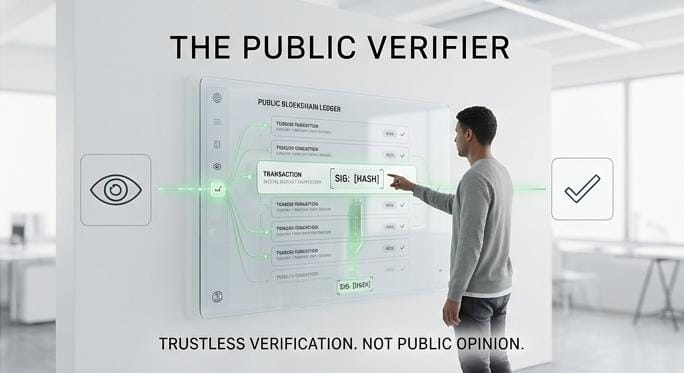
When I look at public blockchains through this lens, things fall into place fast. Every transaction I see? Just a signed attestation. Every balance update? Signed. Minting, burning, transferring it’s all signatures being created, verified, and agreed upon in public. That’s where the trust comes from. Not from a company, not from a narrative, but from the ability to verify everything myself.
And I like that even more.
I don’t have to believe anyone. I don’t need a roadmap or a promise. If I can see the signatures and validate them, I’m done. That’s enough.
But then I started thinking about the other side of the equation the part that doesn’t get as much attention. Permissioned systems. Private networks. The places where not everyone gets to participate, where access is controlled, and where performance actually matters.
At first, it felt like a completely different world. But the more I looked at it, the more I realized it isn’t.
The logic doesn’t change.
It’s still signed state transitions.
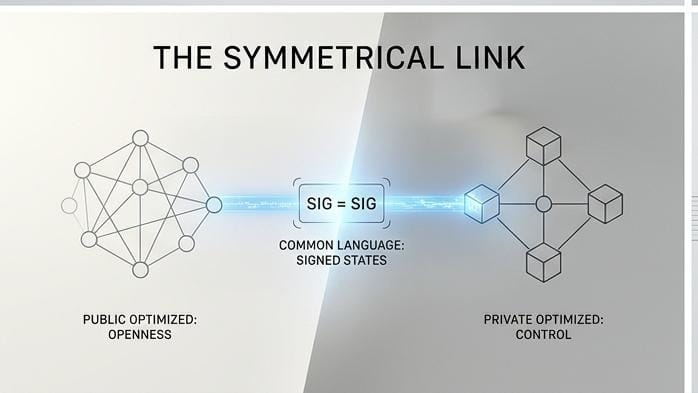
Whether I’m dealing with a public chain or a permissioned network, the core idea holds. Participants sign off on changes. The only real difference is who’s allowed to sign and who’s allowed to see. That’s it. Same system. Different gatekeepers.
And that’s where something interesting starts to happen. I begin to see Sign Protocol not just as a tool, but as a kind of common language. Public or private, it doesn’t matter. Both sides speak in signed data. A balance update doesn’t suddenly become something else just because it’s happening in a controlled environment. It’s still a signed statement. A transfer is still a signed statement.
That symmetry feels powerful.
Because now I’m not trying to stitch two different worlds together. I’m expressing the same truth in two different environments. One optimized for openness. The other for speed and control. But underneath, it’s the same logic, the same structure, the same idea of truth.
Of course, once I got comfortable with that idea, I ran into the next thing people love to talk about: performance. Big numbers. Claims like 200,000+ transactions per second on the permissioned side.
And yeah, I’ve seen enough of this space to know better than to get impressed too quickly.
Throughput by itself doesn’t mean much to me anymore. What matters is what’s actually being processed. If I’m dealing with lightweight signed attestations instead of heavy computation, then of course things are faster. I’m verifying signatures. I’m ordering events. I’m not executing complex logic every single time.
That’s a completely different workload.
So the speed makes sense, at least in theory. But the real question I keep coming back to isn’t about speed. It’s about consistency.
Because this is where things stop being simple.
If I’m running a system across both public and permissioned environments, I need them to agree on reality. Not most of the time. Not “close enough.” Always. If the state on one side drifts from the other even slightly then I’ve got a problem.
Balances can’t disagree. Supply can’t split into two versions of truth. Signed states have to remain aligned, or the entire premise starts to crack.
And honestly, that’s the part that doesn’t show up on slides or in announcements. Syncing truth across environments isn’t flashy. It’s hard. It’s messy. It’s where systems either prove themselves or quietly fail.
Still, I can’t ignore what I appreciate about this approach.
It doesn’t try to reinvent everything. It doesn’t pretend to create a brand-new universe of consensus. It starts with something fundamental: signatures. It treats them as the core building block, not as a side effect. Everything else the chain, the network, the environment becomes a way to transport and organize those signatures.
That feels grounded to me.
It also forces a certain kind of discipline. I can’t hide behind complexity. If something breaks, I have to trace it. Who signed what? When did it happen? Why was it accepted? There’s accountability built right into the system.
And in a space where a lot of projects still rely on narratives more than clarity, that stands out.
But I’m not naive about it either.
There are still open questions. A lot of them. Cross-environment consistency isn’t a solved problem. Incentives, coordination, edge cases they all add friction. And the market doesn’t always reward clean architecture. Sometimes it rewards hype, speed, and timing instead.
I’ve seen investors chase trends that barely make sense, while more thoughtful systems get overlooked because they don’t scream loud enough. That’s just how this space moves.
So I keep digging. Not because I think this is “the answer,” but because it feels like a solid way to think. A better mental model, at least.
At the end of the day, I keep coming back to the same idea: truth in distributed systems isn’t about chains or branding or TPS numbers.
It’s about who signed what and whether everyone agrees on it.
And now I’m left wondering if everything really does come down to signatures, then is this approach quietly pointing toward the future of how we build systems or is it just another elegant idea that works beautifully in theory but struggles when it meets the real world?