
I’ve just been sitting with this lately… not trying to rush into a conclusion, just letting the idea settle in my head… because every time I look at Sign Protocol, I don’t get that usual “this is clearly bullish” feeling… it’s more like I’m slowly realizing what it actually implies, and that realization is a bit heavier than it first looks.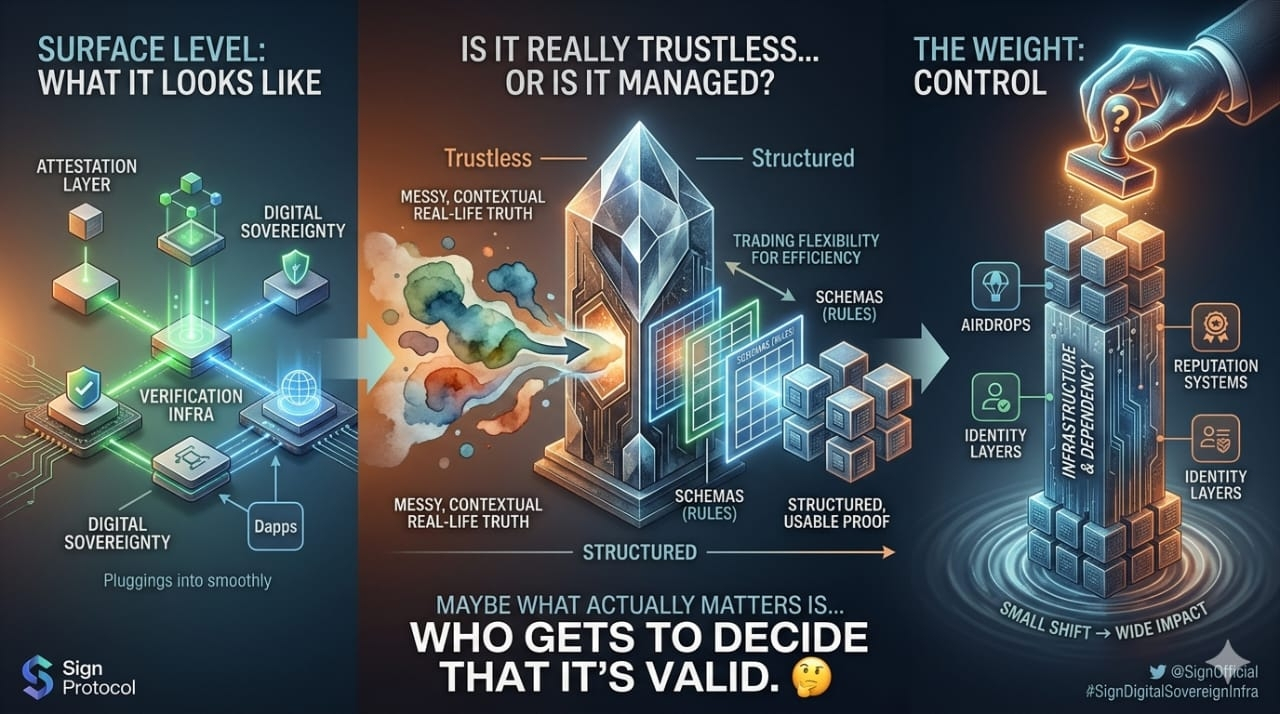
At surface level, it’s easy to label it.
“Attestation layer.”
“Verification infra.”
We’ve heard all that before.
But when I try to break it down in simple terms… it feels like Sign isn’t really dealing with truth. It’s dealing with what a system is willing to accept as truth.
And that shift… it’s small, but it changes everything.
Because in real life, truth isn’t clean. It’s messy, contextual, sometimes even arguable. But the moment you bring it into a system like this, it has to be structured. Defined. Fitted into a format. Otherwise it can’t move, it can’t be verified, it can’t be reused.
That’s where schemas come in… and honestly, this part doesn’t get talked about enough.
Schemas sound boring, but they’re basically rules.
They decide what kind of data is valid… and what gets ignored.
If your identity, your credentials, your history fit inside that structure, then it becomes usable across apps. If it doesn’t… then for the system, it’s almost like it doesn’t exist.
And that’s where I slow down a bit.
Because once everything is standardized like that, you gain efficiency… but you lose flexibility. Every platform reads you the same way. No room for interpretation, no context, just structured proof moving around.
At first that feels powerful.
But then you start wondering… who decided that structure in the first place?
Then I look at the infrastructure side, and this is where it gets interesting in a different way. SDKs, indexers, explorers… not exciting stuff, but this is what actually drives adoption. Developers don’t care about narratives, they care about ease. If something is simple to plug into, it spreads.
So if Sign becomes the easiest way to handle verification, it won’t need hype.
It’ll just quietly become part of how things are built.
And that kind of growth… you don’t really notice it until it’s already everywhere.
From there, the applications start stacking—airdrops, reputation systems, identity layers… and slowly, more and more systems start relying on the same base layer of verification.
That’s where dependency creeps in.
Not suddenly… just gradually.
Until one day, everything is connected to the same source of truth.
And if something goes wrong there even a small shift.it doesn’t stay isolated. It spreads across everything built on top of it.
But honestly, the real weight of this whole thing sits somewhere else.
The trust layer.
Because this is where it stops being about tech… and starts being about control.
If institutions, governments, or large entities start deciding which schemas are valid, which attestations are acceptable, which sources are trusted… then even if everything is running on-chain, the control hasn’t disappeared.
It’s just moved.
And at that point, it doesn’t feel fully trustless anymore.
It feels… managed.
Maybe that’s necessary. Maybe systems at scale *need* that kind of structure. But it’s still a trade-off, whether we admit it or not.
That’s why I can’t look at Sign and just blindly get excited.
But I also can’t ignore it.
Because the problem it’s trying to solve is real. Web3 still doesn’t have a smooth way to carry identity, reputation, or history across platforms without relying on centralized checks. And Sign is trying to build that missing layer in a way that actually works.
Even the whole omni-chain approach shows that ambition… same logic across different chains, trying to keep everything consistent. Sounds strong, but also fragile. Because different chains behave differently. Keeping trust aligned across all of them isn’t simple.
And if that alignment breaks… things can fall apart quietly.
So when I step back and look at it honestly, Sign doesn’t feel like hype.
It feels like infrastructure.
The kind that sits in the background… doing its job without noise.
And if it works, most people won’t even notice it’s there.
But if it doesn’t… it’ll be very obvious.
And I keep coming back to the same thought, no matter how I try to look at it.
Maybe it’s not enough that proof exists.
Maybe what actually matters is…
Who gets to decide that it’s valid.