I’ve been thinking about sovereignty for a long time and honestly, how much of it really survives once infrastructure becomes shared.
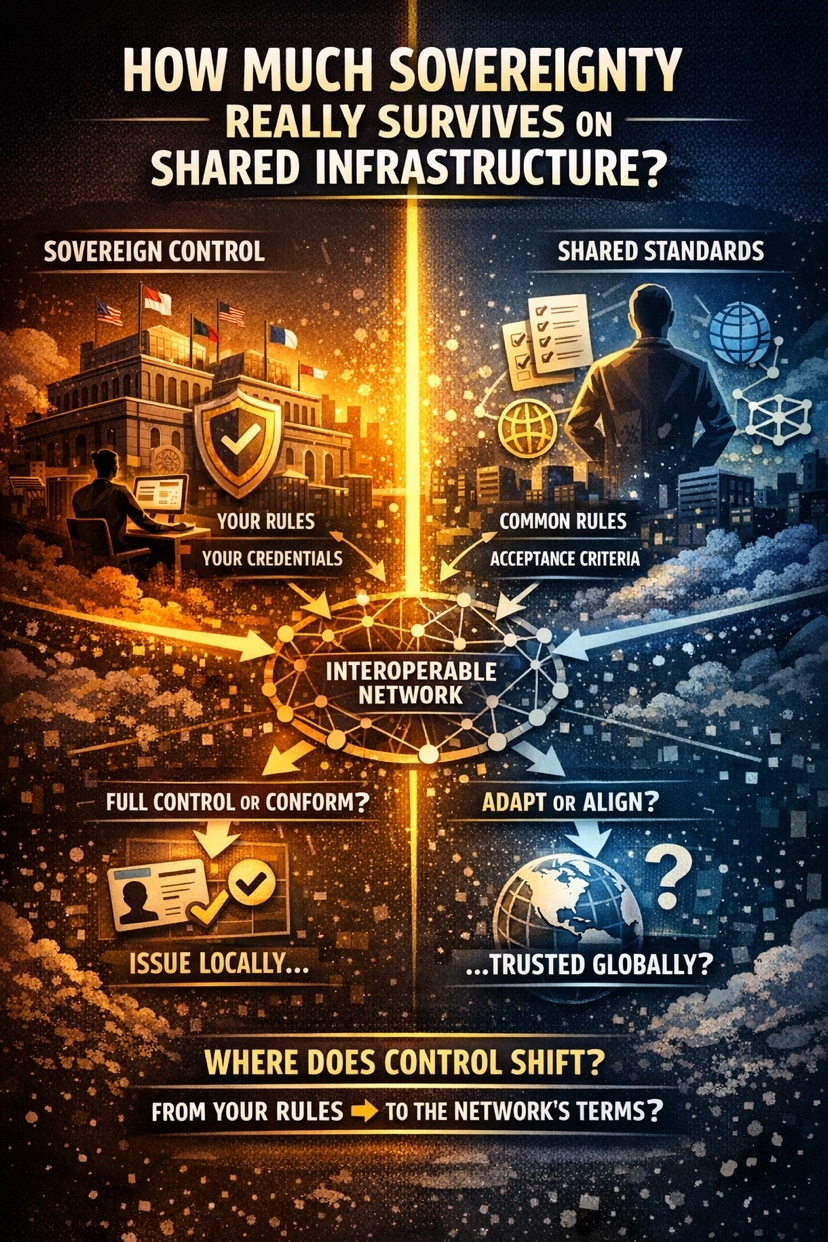
Projects like @SignOfficial talk about sovereign control in a very appealing way: each government or institution sets its own rules, issues its own credentials, and enforces its own policies. Nothing gets overridden. Authority stays local.
On paper, that sounds like sovereignty is fully preserved.
But the moment infrastructure becomes shared, sovereignty starts to change shape.
Because even if you control what you issue, you don’t fully control how that credential is interpreted somewhere else.
A credential may be valid inside your own system, but another system decides how much weight it gives that credential. It decides whether to trust your issuer, partially trust it, or ignore it completely.
So sovereignty at the point of issuance does not automatically mean sovereignty at the point of recognition.
And recognition is where sovereignty becomes real.
That’s where the question gets more complicated especially once shared standards enter the picture.
If systems want interoperability, they need common formats, common rules, and common expectations. But standards never come out of nowhere. Someone defines them. Someone updates them. And over time, they start shaping what counts as a “valid” or “acceptable” credential across the network.
So even without direct coercion, pressure to conform still exists.
Because the further you drift from shared standards, the harder it becomes for your credentials to be useful outside your own environment.
That means sovereignty may still exist technically but in practice, it starts becoming constrained.
That’s why I find this balance so interesting.
$SIGN seems to be building a framework where systems can connect without fully merging. That’s the promise. But once participation in that network becomes valuable, the cost of not aligning starts rising too.
And that’s where the real tension begins:
Do you preserve full control and risk isolation?
Or do you align with shared infrastructure and gradually absorb external influence?
So the question I keep coming back to is this:
How much sovereignty actually remains once systems depend on each other to function?
And at what point does control slowly shift from what you define internally… to what the network is willing to accept externally?