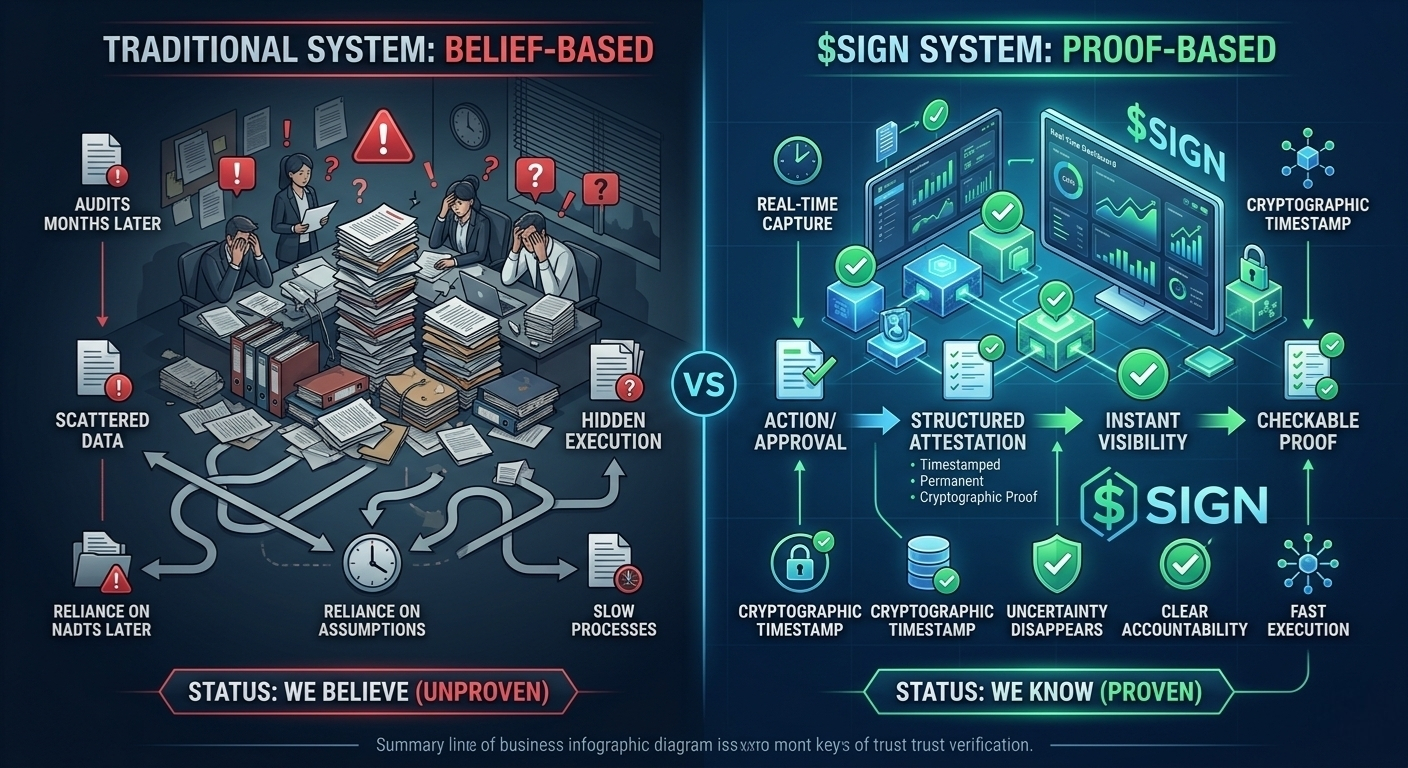
One morning, I was at my desk while working on a small project we were trying to handle. Paper-wise, everything seemed okay. We had shared spreadsheets. Updates were sent. The team even assured me that all approvals were done. I believed it for a while. However, when I tried to find out exactly who had approved what and which milestones had been actually done, I found myself blocked. There was no straightforward method to check. The data was somewhere, but it was so scattered, untidy, and unorganized for this type of verification in real time.
Initially, I thought it was just one more example of poor communication. However, after a few days, I noticed this was happening in bigger projects as well. Everything seemed like it was going according to plan, but the real face of execution—the part that really counts—was hidden. It dawned on me that this was not a case of people failing. Instead, it was about systems that have been set up to show results later, rather than as things happen.
Reports will be delivered weeks or months later. Audits are done even later. Dashboards, if present, usually show summaries and not the real-time chain of decisions. By that time, the story has been written already. We count on belief. On assumptions. On promises. This is how most systems function.
Then I found $SIGN. At first, I thought it was just another app to record approvals or store digital signatures. When I understood it well, I saw. Then I realized that the matter was arranged perfectly and any mistake could be easily seen and proven.Every attestation—like “This approval happened,” “This condition was met,” or “This milestone is complete”—is timestamped, structured, and permanent. It’s not flashy or complicated, just practical, but it makes verification possible at any moment.
I decided to give it a try on a small pilot project. Every action, every approval, every compliance check, and milestone was captured in real time. Suddenly, the uncertainty I usually feel disappeared. Delays became obvious the moment they happened. The wrong words could no longer be hidden. The things you can say are wron
I keep returning to the same thought: most systems today prove what happened only after the fact. $SIGN tries to make the process verifiable while it’s still unfolding. Not loudly. Not dramatically. Step by step. In fast-moving environments where capital moves quickly and trust spans multiple institutions, this approach could become essential. Or maybe it remains a middle layer people acknowledge but do not fully depend on. Either way, it makes me question whether the real problem was ever about policy—or about the lack of a way to follow it into reality.
$SIGN turns trust into something you can check yourself. Piece by piece, step by step. It’s not perfect. It doesn’t capture every nuance. But it shifts trust from assumption to proof. In my experience, when every step is structured and verifiable, uncertainty drops. Decisions become clearer. Accountability works. It’s subtle, but it changes the way we see execution. It redefines what trust can mean in practice.