I first stumbled across SIGN while scrolling through charts late one night, that kind of half-curious, half-bored way you check tokens after a big TGE. At first glance, it felt like the usual story: a massive post-TGE bleed, ongoing unlocks, and a token supply that seemed destined to crush any hype before it could even build. Honestly, my first thought was, “Yeah, maybe check back in a few months.” I almost left it at that, because I’ve seen plenty of projects that look solid on paper but can’t escape their own token structure.
But something kept nudging me back. It wasn’t price action or social media chatter it was a mismatch between what the charts were telling me and what the team was actually building underneath. The more I dug in, the less the surface-level narrative made sense compared to the infrastructure being quietly assembled. I found myself stuck in this awkward middle ground where I couldn’t fully dismiss it, but I also couldn’t blindly buy in.

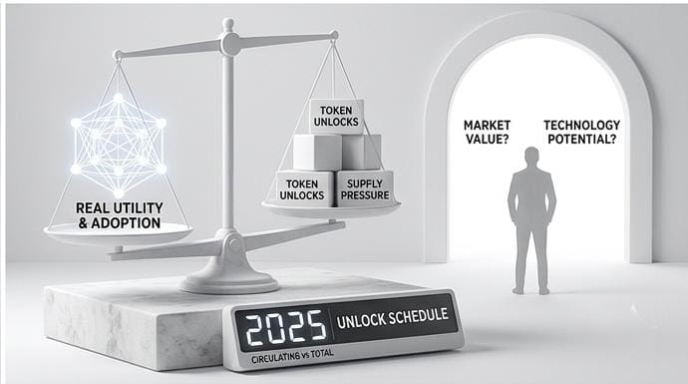
At a simple level, the thesis is actually clean. Either SIGN is quietly building real, institutional-grade infrastructure that the market hasn’t priced yet or the market is right to discount it because the token’s structure makes it extremely hard to benefit from that progress. And the funny thing is, both of those can be true at the same time.
What really caught my attention was how the system actually works. Strip away the buzzwords, and SIGN’s stack is trying to solve one big problem: how do institutions trust data without constantly verifying it over and over? That’s where the Sign Protocol comes in. It’s basically a credential system where an authority can issue something verifiable on-chain, and anyone else can check it without redoing the whole process. I think of it like a “stamp of truth” that doesn’t need to be reissued every time someone asks for it.
Then there’s TokenTable, which is already operational for token distributions, vesting, and airdrops. I love that part because it’s not theoretical it’s in use. Projects rely on it because once you plug your distributions into it, switching mid-process is messy and risky. EthSign handles documents: signing agreements, verifying records, and anchoring them in a way that can’t be quietly changed later. What’s cool is these aren’t isolated tools they’re built on the same underlying primitives. Zoom out, and it’s less about separate products and more about a system that can slot into existing workflows without forcing institutions to rebuild everything from scratch.
I also found the dual-chain setup fascinating. There’s a public Layer-2 for general use and a private network designed for central bank or government-level operations. That kind of detail matters. You don’t design a private CBDC-compatible network unless someone with serious, real-world constraints asked for it.
Of course, this isn’t a perfect story. The project is generating revenue TokenTable reportedly did meaningful volume relative to the market cap, which is rare but the token itself is under constant pressure. Circulating supply is still a fraction of total supply, and unlocks keep happening. Even if the product improves, the token can struggle just because new supply hits the market. I’ve seen this before: good product, tricky timing, or more accurately, a solid product trapped inside a token structure that doesn’t let the market fully reward it. And markets usually don’t wait around for that to resolve.

I think people simplify SIGN too much. They treat it as a supply problem, ignoring the other side: real utility. If this system actually gets integrated into government or institutional workflows, demand dynamics could change completely. That’s hard to model, so most investors ignore it and just focus on the sell pressure. I get it uncertain future usage is messy but that’s also what makes it interesting.
The risks are real. This depends on institutional adoption. If governments or large systems don’t integrate the tech meaningfully, the whole “infrastructure” narrative weakens. Execution risk is there too building something technically sound is one thing; getting it adopted across slow-moving, regulation-heavy systems is another. And then there’s the constant reminder of token dynamics. Unlocks don’t care about narratives they happen on schedule.
Still, I can’t shake the feeling that the market is underpricing the optionality here. Usually, there’s at least some speculative premium for “what could be.” With SIGN, it feels like the market is almost deliberately ignoring that upside. Maybe that means the opportunity is real. Or maybe it means the market has seen enough stories fail that it’s refusing to give the benefit of the doubt. I honestly don’t know yet.

What would change my mind? Seeing consistent, verifiable usage tied to real systems credentials issued, verified, and reused across workflows not just announcements or pilot programs. That’s when this goes from “interesting infrastructure” to actual embedded utility. If the story stays stuck at potential while token pressure persists, the market may be right to discount it, and it becomes another example of good tech failing to translate into investable value.
Right now, I’m somewhere in between. SIGN doesn’t feel like noise. Something real is being built, and the architecture shows that. But the token structure makes it hard to fully express that conviction. I can believe in the product and still hesitate on the token. Those are always the trickiest cases to navigate, because sometimes the gap between reality and price closes and sometimes it just doesn’t.
So here I am, watching, learning, and asking myself: when a project quietly builds something meaningful, but the market refuses to see it, is it a rare opportunityor just another experiment that may never escape its own token economics?