
@SignOfficial $SIGN #SignDigitalSovereignInfra I keep returning to the same pattern, though I try not to do it too quickly. The language changes a little. The framing becomes more refined. The visual layer improves. But once I stay with it long enough, the outlines start to blur together. What is presented as a new structure often carries the same unresolved assumptions as the last one. I have seen this enough times that I no longer feel much urgency around the initial claim. I pay more attention to what survives a second look.
The central promise is usually easy to understand. A system will establish trust at scale. It will verify who should be verified, distribute what should be distributed, and do so with enough efficiency to justify the complexity beneath it. On paper, that logic appears stable. In practice, it remains difficult in ways that are rarely addressed with the same clarity used to describe the ambition.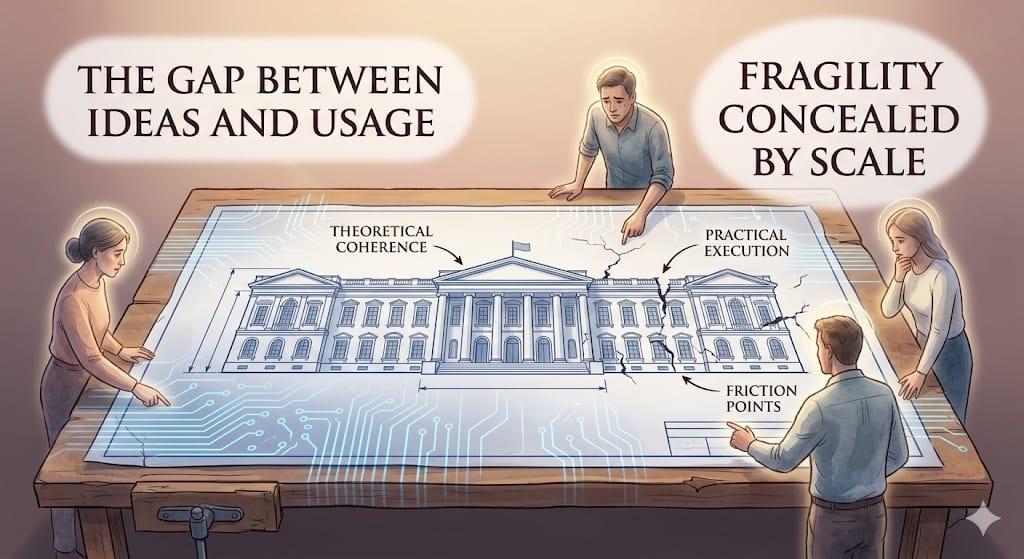
I notice, first, how quickly narratives begin to repeat. There is always a language of coordination, fairness, access, and legitimacy. There is always a suggestion that identity can be made portable without becoming invasive, and that distribution can be made efficient without becoming extractive. These claims are arranged carefully enough to sound complete. After a while, the repetition stops reinforcing confidence and starts flattening distinctions. Different systems begin to resemble each other, not because they have converged on something durable, but because they have learned the same vocabulary for unresolved problems.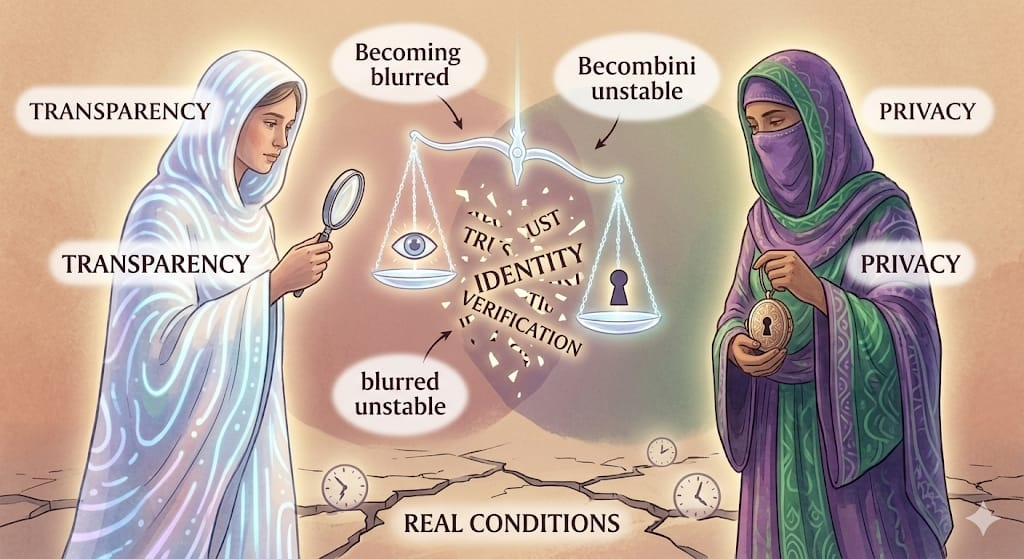
The tension between transparency and privacy remains one of those problems. I do not think it has been settled in any meaningful sense. I see systems leaning toward visibility in the name of trust, then presenting that visibility as a neutral condition. Exposure becomes ordinary by repetition alone. It is framed as necessary, then practical, then acceptable, until the threshold itself disappears. I have grown wary of that sequence. A thing does not become reasonable merely because enough infrastructure has been built around it.
At the same time, the attempted corrections are often no better. Privacy is treated as a total counterweight rather than a design constraint that must coexist with actual use. The result is usually another imbalance. The system becomes harder to interpret, harder to integrate, harder to rely on under ordinary conditions. It protects itself by becoming distant from the environments where it is supposed to work. I can understand the impulse behind that. I do not think it produces stability.
This is where I start separating coherence from function. Many systems are designed to sound internally consistent. That is not the same thing as holding together when they encounter uneven reality. Real conditions introduce misuse, indifference, latency, conflicting incentives, incomplete participation, weak interfaces, and the simple fact that most people will not tolerate friction unless the value is immediate and obvious. I find that this is still treated as an implementation detail when it is closer to the core of the problem.
The infrastructure itself rarely seems to be tested where it matters most. It is assessed in controlled settings, among aligned participants, under assumptions that favor success. That kind of testing has its place, but it tells me very little about endurance. I am more interested in what happens when conditions become inconvenient, when participants are only partially informed, when incentives stop lining up cleanly, when the system has to absorb pressure without appealing to explanation. That is where trust either thickens or collapses. Most proposals still seem optimized for the earlier stage, the one in which legibility matters more than contact with the real environment.
Developer friction sits quietly inside all of this. It is not dramatic enough to dominate the narrative, so it is often treated as secondary. I do not think it is secondary. Systems that require too much patience from builders will not be adopted in the durable sense. They may be demonstrated. They may be announced. They may attract temporary attention. But real usage depends on repeated decisions made under time pressure by people who are comparing effort against uncertain return. If the path remains heavy, adoption narrows. Once adoption narrows, the system begins to depend on narrative again.
This is usually the point where token structures are introduced as alignment tools, growth mechanisms, or participation incentives. I have become more restrained in how I look at that layer. I do not reject it automatically. I simply no longer assume that adding a token improves the system it surrounds. Too often it introduces a second logic that competes with the first. What is supposed to support utility starts distorting it. Distribution becomes a spectacle. Participation becomes performative. Attention shifts toward positioning rather than use. When that happens, the token does not clarify the structure. It exposes the uncertainty inside it.
I keep noticing how often trust, identity, and verification remain inconsistent even when they are described as foundational. There is usually an implied confidence that these elements can be made interoperable across different contexts without carrying over the instability of those contexts. I have not seen much evidence for that. Trust does not transfer cleanly. Identity does not remain stable when incentives change. Verification is rarely neutral for long. Each one becomes fragile in contact with scale, governance, or market pressure. Together they become even less predictable.
The gap between ambition and real usage has not narrowed as much as the language suggests. In many cases it feels wider, because the ambition has become better at disguising weak execution. Large ideas create a useful surface. They absorb criticism by increasing abstraction. Any failure at the operational level can be reframed as an early-stage limitation, a temporary bottleneck, or a matter of incomplete adoption. That framing can continue for a long time. It delays judgment without necessarily earning it.
I find myself paying closer attention to ordinary evidence now. Not declarations of scale, but signs of dependable use. Not statements about future coordination, but whether people return without being pushed. Not the elegance of the framework, but whether it reduces burden where burden is actually felt. Those measures are less flattering, but they are harder to manipulate. They also reveal how often visibility is mistaken for substance. Market behavior still rewards what can be seen, repeated, and circulated. It is less patient with what only becomes visible after endurance has been established. That imbalance shapes the entire field more than many admit.
Because of that, I have become less interested in whether a system can be narrated persuasively. I want to know whether it can tolerate pressure without fragmenting into exceptions, disclaimers, and temporary explanations. I want to know whether privacy remains intact without turning unusable, whether verification remains useful without normalizing exposure, whether trust can be reinforced without being constantly externalized into signaling. I want to know whether adoption emerges from reduced friction or merely from incentives that can disappear as quickly as they arrive.
Most of what I see still feels too dependent on presentation. The structures are often ambitious enough to attract belief but not disciplined enough to withstand contact with real conditions. They can explain themselves at length, but explanation is not proof of resilience. I think that distinction matters more now than it did before. Repetition has made it harder to be impressed by the familiar sequence of claims. It has also made the remaining questions easier to identify.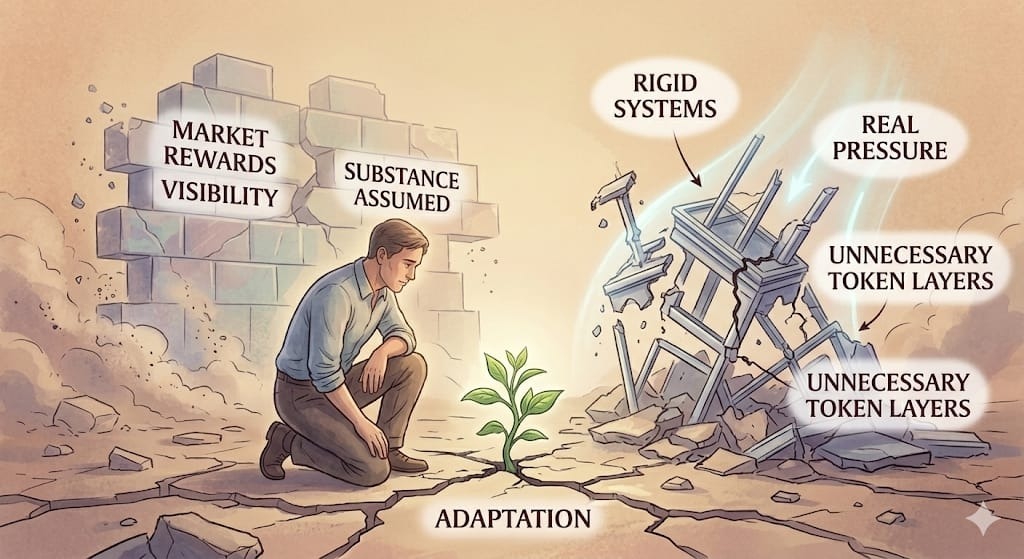
I do not assume bad intent. That is no longer the frame I find most useful. The issue is more structural than personal. Systems inherit the incentives around them. Markets reward visibility. Builders compress complexity into coherence. Communities normalize exposure because it simplifies coordination. Privacy is then reintroduced in forms that protect principle while straining utility. Tokens are used to accelerate trust where trust has not actually been earned. Identity becomes a moving target. Verification becomes situational. The language remains stable while the underlying conditions do not.
So I keep narrowing my focus. I look less at ambition in its announced form and more at endurance in its quiet form. I look for the points where the structure is forced to reveal what it depends on. Under pressure, the unnecessary parts usually become obvious. So do the absences. What remains after that is often much smaller than the original claim. Sometimes it is still useful. Sometimes it is finally legible. Either way, it is more honest.
That is where my attention stays now. Not on whether the system sounds complete, but on whether it holds when the protective narrative falls away.