

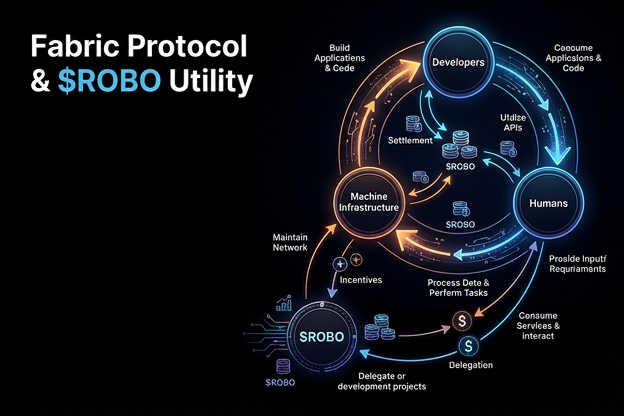
@Fabric Foundation . A machine was just something that followed instructions. It could move, calculate, repeat, maybe even adapt a little, but it still felt like a tool waiting for a human to tell it what to do. Then I started looking into Fabric Protocol and the idea behind ROBO, and the question changed for me. What if machines were not only tools? What if they could actually take part in an economy? What if a robot could complete a task, prove it was done, earn for that work, build reputation, and even have a role in how the network evolves? That is the bigger thought behind ROBO . It is not only about a token. It is about whether robotics, AI, and blockchain can come together to create a system where machines are coordinated through shared incentives instead of closed company platforms.
That is what makes Fabric Protocol feel different. It is trying to build the foundation for what it calls a machine economy. In simple terms, ROBO is meant to support things like robot identity, task settlement, incentives, delegation, governance, and network participation. That may sound technical at first, but the core idea is easy to understand: if machines are going to do real work in the future, they may also need a way to operate inside an open economic system. A token in that kind of design is not just decoration. It becomes part of the structure that keeps the system running.
What caught my attention is that this is not only about software living on screens. It is about physical machines interacting with digital rules. Fabric’s vision points toward a world where robots can take on tasks, exchange value, and operate inside a shared network rather than inside isolated ecosystems owned by a few companies. That makes the project feel larger than a normal crypto narrative. It is trying to connect the digital economy with the physical world.
And that matters because AI is already changing how we think about work. Robotics takes that conversation one step further. Once machines can inspect warehouses, collect data, assist with services, or perform repetitive jobs, the real question becomes bigger than intelligence alone. Who pays them? Who benefits from their output? How is the work verified? How do you stop abuse? How do you create trust in a system where machines are acting more independently? Fabric’s answer is to use blockchain-based coordination and token incentives to make that possible.
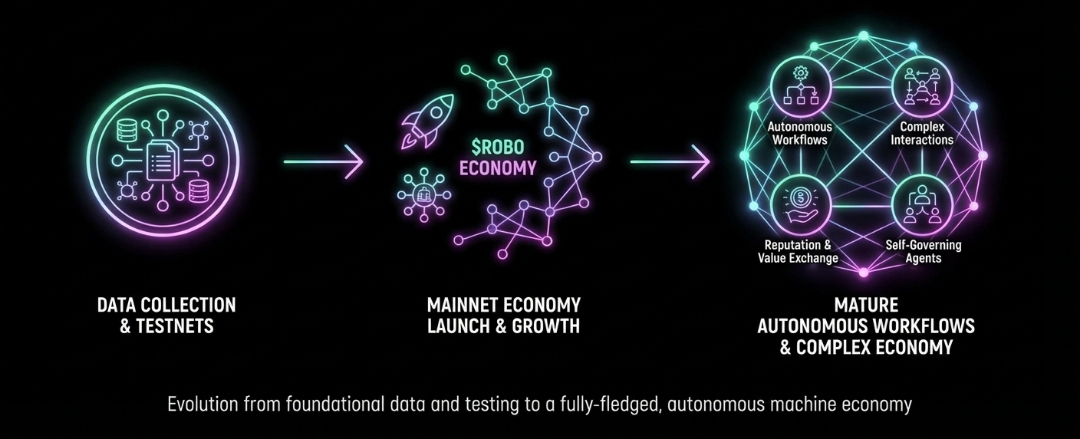
The roadmap shows that this is still early. The project is moving in stages, starting with prototypes and data collection, then building toward stronger open infrastructure, a testnet, and eventually a dedicated Fabric mainnet. The shorter roadmap is even more practical, focusing first on robot identity and task settlement, then contribution-based incentives, then more complex workflows involving multiple machines. So this is not a finished story yet. It is still an experiment becoming a system.
From the token side, $ROBO also has a clearer design than many projects in this sector. The supply is fixed, the allocations are defined, and the vesting structure gives people something concrete to evaluate. That does not remove risk, but it does make the project easier to analyze. In a market full of vague token models, clarity matters.
Still, the market side is where things become more complicated. Right now, $ROBO still trades like an early narrative asset. It has strong volatility, changing sentiment, and the kind of price behavior that usually shows a market trying to decide what the project is really worth. That means the idea may be strong, but the proof is still developing. At the moment, the market seems to be valuing future possibility as much as present adoption.
There are definitely reasons people find the project interesting. The first is timing. AI and robotics are growing themes, and Fabric sits right where those two worlds meet blockchain. The second is structure. Unlike many AI-related tokens, ROBO is trying to connect its token directly to actual network roles like settlement, delegation, governance, and verified work. The third is credibility. The broader ecosystem around OpenMind and Fabric has attracted serious attention, which gives the project a stronger foundation than many trend-driven ideas.
But the risks are real too. Robotics is not easy. It is far more demanding than building software alone. A decentralized exchange only needs code, liquidity, and users. A robotics economy needs hardware that works, systems that stay safe, data that can be trusted, and machines that perform reliably in the real world. That is a much harder challenge. And once machines start moving into commercial or public environments, regulation becomes a serious part of the story. Safety, liability, labor effects, and accountability all become impossible to ignore.
That is why I think the real challenge for ROBO is not whether the idea sounds impressive. It does. The real challenge is whether the network can create real, lasting usage. For this kind of model to work, developers need to build on it, operators need incentives to participate, and users need services that feel useful enough to adopt. Without that, the token risks becoming a market story before it becomes a working economy.
What makes ROBO interesting to me is not the hype around AI. It is the deeper question underneath it. Crypto has spent years thinking about how humans coordinate value. AI has spent years thinking about how machines can become more capable. Fabric is part of a smaller group trying to connect those two ideas through robotics. That means asking a very unusual question: can machines become economic participants in systems that humans still oversee?
That question feels strange, but it also feels important. It pushes us to think differently about work, ownership, incentives, and trust in a world where software is no longer limited to screens. If Fabric succeeds, even partially, ROBO could matter not because it followed an AI trend, but because it helped explore what a machine economy might actually look like.
So when I think about ROBO now, I do not only see a token. I see an early attempt to answer a bigger question about the future. Can machines work, earn, and decide inside an open network? Fabric Protocol is trying to test that idea in the real world. Whether it succeeds will depend on execution, adoption, and regulation much more than market excitement. But as a concept, it is one of the more thoughtful ideas in this space right now.
